Very nearly 3 decades ago, I got involved in an American lawsuit.
Forsyth v Eli Lilly
Bill Forsyth was a wealthy man even before he sold the land his car rental business was on to Los Angeles airport. He and his wife, June, left Los Angeles for Maui in 1990, which as anyone who’s been there knows, is idyllic. It also gave June and Bill easy access to their 3 grandchildren and to Bill Jr and his wife Karen. Still a relatively young 65, with nothing to occupy him, Bill Sr found it a little too quiet. He missed the LA buzz. He was pushing to move back at least part-time but June was beyond happy with her family, her Church and a new network of friends.
In early 1992, Bill got put on a sleeping pill that didn’t suit him. This led through a few other pills to a trial of the still new Prozac. He called his doctor the next day to say he was feeling fabulous and was told – Yep, this is the Prozac Miracle. The day after was very different. Never having been anywhere near a mental facility in his life, he checked himself into a mental health unit. His family, and the staff at the hospital, were bewildered. No one could see anything mentally ill about him but despite this six days later the staff were uncomfortable about letting him check himself out.
June and Bill Jr saw an agitated ashen faced man when he came home. The next day Bill and June were due to go out whale watching with Bill Jr. When they didn’t turn up, Billy called to the house and found June stabbed horrifically and Bill impaled on a knife strapped to a chair. There was blood everywhere.
Two years later, in 1994, a Fentress v Eli Lilly lawsuit went to trial – five years after Joseph Wesbecker, prescribed Prozac, entered his place of work in Louisville where he shot dead 8 work colleagues, wounded 12 others and killed himself. Lilly appeared to win the case and told the world don’t ever bother attempting to sue us again – Depression, not Prozac causes problems like this.
In the wake of this verdict, a host of other cases quietly settled. Almost none were left except Susan and Bill Forsyth’s case against Lilly.
It turned out that the Fentress case had illegally settled and the verdict was overturned, making it easier to proceed with a new case.
Innocence
This led to me getting an email from a California law firm asking me if I’d be prepared to be an expert in a Forsyth v Eli Lilly case. One reason I was approached was that I’d written a 1991 paper on two men whose cases indicated Prozac has a capacity to cause suicide – Antidepressant Induced Suicidal Ideation. But the key reason was likely because the lawyers could not find a US expert.
I had no interest in law and had never imagined taking on a legal case. I was probably on the side of lots of doctors who think that getting involved in legal cases creates a conflict of interest that is almost worse that liaising with pharma.
I had no idea what the consequences of participating in this legal case might be. An innocent abroad – would have been a good description. I didn’t think all that closely about how weird it was that a Californian law firm was contacting someone in the back of beyond. When they met me, the Forsyth lawyers must have wondered were they making a bad mistake but they had only a few weeks left to file.
A few weeks later I was being deposed by Lilly’s lawyers – Shook, Hardy and Bacon – then the lead lawyers for the tobacco industry. I had no idea what a deposition was. Lilly’s lawyer for this must have also wondered about where I’d come from. Once the deposition began, it must have been clear to him, I had no idea what was going on. He was very relaxed, probably because something neither I nor the Forsyth lawyers knew about was that in the years between writing the article about Prozac and suicide, Lilly had taken several steps to make it look to any court that I had to be removed from being an expert against them because they’d consulted with me and given me privileged information. They gone so far as having one of their lawyers have what seemed to me like a friendly and informal meeting with me, but it was now clear companies like Lilly were in fact leaving nothing to chance.
Neither set of lawyers had taken into account a superpower that not even I knew I had. I’m Irish. This means we talk in circles. Useful in depositions. Lilly’s lawyer got very frustrated with this – this was the only hint I had that things might not turn out completely disastrously.
Hawaii
It took 18 months from the deposition, with lots of motions to get me dismissed, before a trial actually happened – in Hawaii. When it did, a new world opened up. I met Skip Murgatroyd who everyone familiar with Study 329 will know about. He took me through a heap of Lilly documents that showed they knew – or at least were very familiar with the idea – that Prozac caused suicide. In one sense, at one level everyone knew about things like this but actually seeing the documents made the whole thing real like nothing else could – or least meant you couldn’t act like nothing was going on.
Not only that – Skip was part of Baum Hedlund who were committed to getting documents like this into the public domain. No point letting documents rot in an archive.
After the first Forsyth trial was over – again Lilly seemed to have fiddled with the process – as part of the getting things into the public domain, I took documents along to Richard Smith, then editor of the BMJ, who everyone thought was a good guy – Vampire Medicine. Smith and BMJ, however, had published the Beasley article 8 years previously, which was the central plank of Lilly’s defense in these cases. He initially muttered that maybe BMJ should do something about all this given the consequences of the Beasley article. But he changed his mind soon afterwards and emailed me saying BMJ would never publish anything I sent them – ever.
The article I’d drawn up for BMJ was almost immediately afterwards published by Graham Dukes editor of the Int J of Risk and Safety in Medicine and one of the world’s leading pharmacovigilance experts – A Failure to Warn.
I had no plans to get involved with any other SSRI or company but didn’t manage the slippery slope all that well and ended up in Pfizer’s archive in a case against them and GSK’s archive in a case against them – finding studies that showed paroxetine and sertraline making people, even healthy volunteers suicidal. Finding documents showing close to every bit of pharma literature is (or was – its AI now) ghostwritten and documents showing ‘friends’ spilling beans to companies designed to discombobulate Healy – after the friends had invited me to come and give a lecture and chatted in a friendly way over a meal afterwards.
Toronto
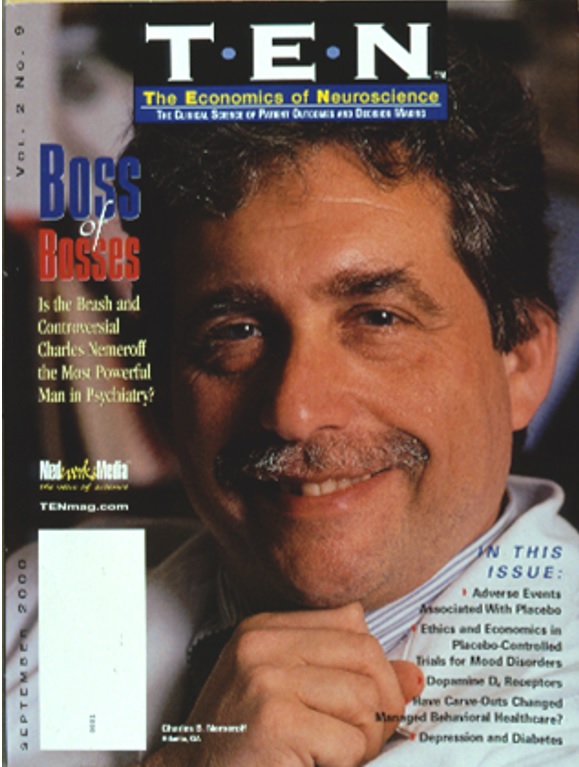
All of this began to mesh with The Boss of Bosses – Charlie Nemeroff – getting me fired from a post in the University of Toronto – see Tweeting While Medicine Burns. And Dave Nutt complaining me to the General Medical Council in the UK – healyprozac.com.
As a result of the Nemeroff Toronto affair, I ended up I contact with Jim Turk and the Canadian Association for University Teachers (CAUT) with whom I filed an Academic Freedom lawsuit against the University. Jim was fabulous as was the utterly extraordinary Peter Rosenthal – a professor of mathematics – who talked himself into being my lawyer by bumping into Jim, then involved in the Healy case, and saying any good lawyer would take that case on for free.
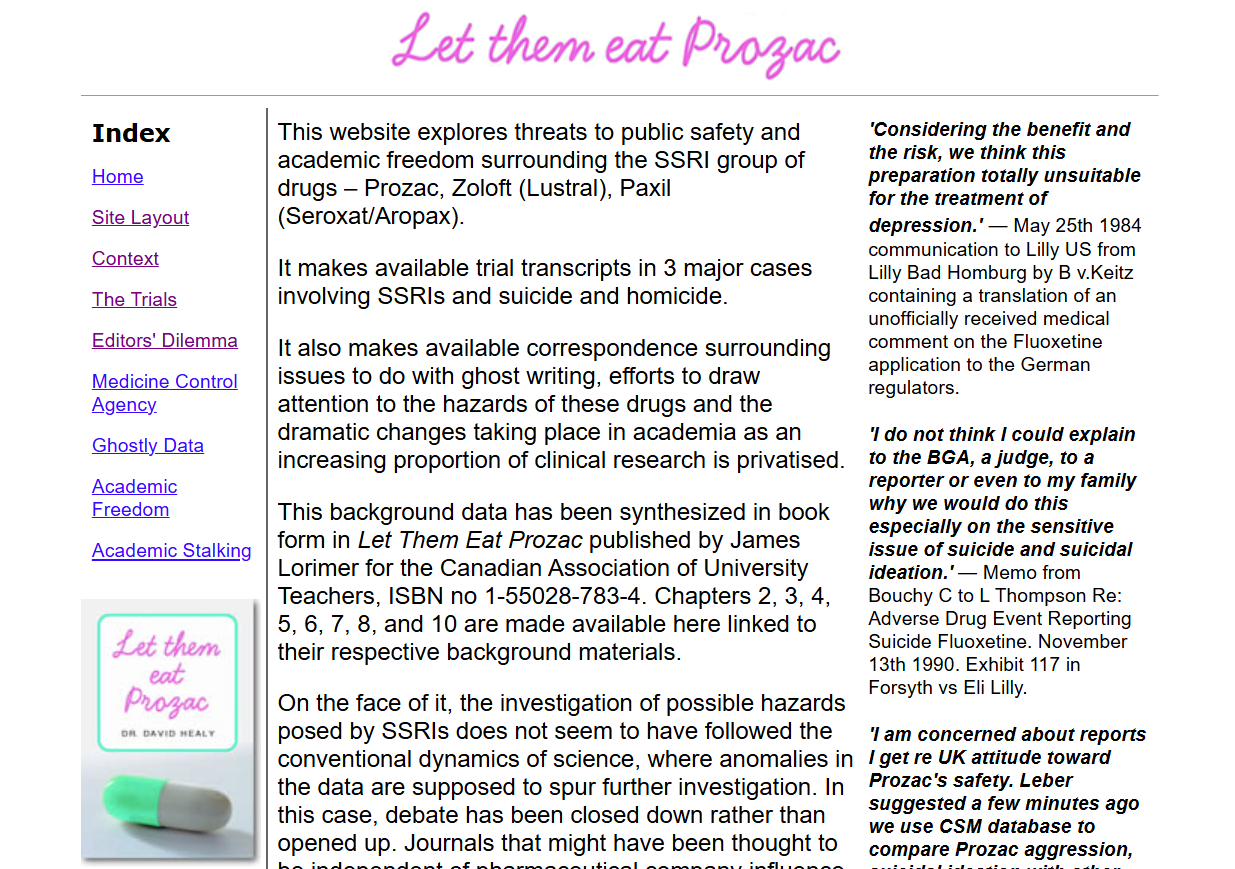
The story was great, the documents were great, the Tobin case was a first ever verdict against any company for the behavioral effects of a drug, and taking an Action against UofT was great. It all merged into a book – Let Them Eat Prozac, first published by Lorimer Press who were closely linked to CAUT, and later by New York University Press. All proceeds from the book have gone to and still go to CAUT’s Academic Freedom fund.
A friend called Bruce Charlton had already put a lot of the documents up on a Pharmapolitics site which gave me who knew nothing about websites and CAUT the idea to host a full set of documents and stuff linked to Nemeroff, Nutt and other disputes on a healyprozac.com site.
Changing Times
A few weeks ago, a colleague who uses the site quite a lot, emailed to say it had stopped working. (Thanks to OB). I contacted CAUT who confirmed that yes their Academic Freedom mission/fund was being terminated and linked to that healyprozac had not been renewed
But fortunately they handed over everything and even more fortunately there are people behind RxISK who keep the show on the road and healyprozac is now back functioning.
Canada now seems to have been a different place back around 2001 – as perhaps many places were. CAUT had an Academic Freedom Fund and supported someone like me in taking an action. That’s now gone apparently – although Academic Freedom and an AF Toolkit and my case still features there – as an historical case (how to feel old).
In between, we had Covid. My instinct was that pharmaceutical companies were unlikely to change their spots. That if they had gotten away with manipulating the data from their clinical trials for SSRIs, ghostwriting everything to the point of portraying negative trials as positive without anyone objecting, perhaps progressively over time even less and less likely to object, why change a game plan that works. See Where Does The Misinformation Come From.
I had some support back tackling these issues linked to SSRIs, but even the hard bitten lawyers who fought some of the SSRI cases I was involved in rolled over when it came to the vaccines and figured companies were likely to be completely honest with something as important as this.
The most striking thing though was the extent to which clinical colleagues with no involvement in any of these issues – with no conflicts of interest of any sort – seem now far less able to consider the possibility never mind see the harms that the vaccines they gave were causing – when you close to had to be blind to miss these problems – Cause and Effect.
Linda Pannozzo in two very recent interviews with David Cayley – a Canadian journalist and broadcaster – maps out many of the Canadian changes in a way that feels right to me. See DC Part 1 and DC Part 2. He outlines how Canadians, and likely all the rest of us, have come to view Folk who don’t immediately follow the herd as Enemies of the Volk.
Healyprozac took shape in more open times. It’s startling to see what was possible then – and is not now.
This is all complete madness. Turning it all around should have been not exactly easy-peasy, not with no evidence, but with a ton of evidence. Winning the Schell case should have been a turning point in litigation case against GSK and Paxil in 2001.
https://www.wisnerbaum.com/blog/2001/july/paxil-maker-held-liable-in-murder-suicide/
‘Healy has written and lectured widely on his view that all SSRIs – Prozac, Paxil and Zoloft – should carry warning labels. He says the drugs viewed as relatively harmless when they came on the market in the 1980’s, could trigger suicidal and violent behaviour in some patients. On the stand in Wyoming, Healy testified that his own studies show that SSRIs could cause one in four healthy volunteers to become agitated, in some cases suicidal. And he said internal Smithkline documents conducted at the company’s request by Beecham labs supported his findings.’
Murgatroyd says, “You only have to do one. The information doesn’t change.”
That’s right, The Study 329 litigation was recently thrown out by a Judge. The GSK UK Group Action was thrown out by a Judge. In 2012 the US Department of Justice fined GSK $3 billion for fraud.
Down and Up, innocence was broad but $3B broader.
GSK Clinical Trials Paxil Fraud
https://www.wisnerbaum.com/prescription-drugs/paxil-suicide-lawsuit/gsk-clinical-trials-paxil-fraud/
– Shook, Hardy and Bacon – almost as good as Ropes and Gray, another of GSK’s legal firms is Slaughter – the irony will be lost…
I came across your name again after watching another true crime video and wondering if this guy who murdered his family and planned to do a mass shooting was affected by his psychiatric medications. I’m tapering off of an antidepressant myself and found that watching true crime somehow is a decent distraction from the mess of symptoms that come and go in no particular pattern. Incidentally, I’m also a doctor and feel like I lost my career to this medication and its effects; though the burnout/moral injury/etc had already started in the last years of med school.
Reading about this case where you testified and the plaintiff won made me tear up. I wish there were more cases like these with such outcomes, and more studies and reports of violent behaviors and any connections to antidepressants.
Do any True Crime cases ever feature antidepressants and if they do do the programs ever give any sense they think the medicines may have played a part?
What was the name of the case you were watching? Would be good if you could make a list of cases involving men who have killed families and have been thinking of killing others. Men like this feature in a more recent post here – Entranced, Spellbound, Mesmerized. No one seems to have any good ideas about what drives men to do things like this – if not the drugs. A few hundred years ago parricide – kill a father was a theme – and often the father struck first. But why kill 3 year old daughters now?
D
They rarely do and only briefly mention it. The first time I noticed was the case of Elisa Lam at the Cecil Hotel. Whichever YT video I watched had mentioned that she had stopped her medication for bipolar or something.
I don’t recall. I was on a free trial of Discovery+ and it was a social media crime series. This was a young man who had moved into his deceased grandparent’s house and was isolated and drinking. He ended up going back to his parents’ house and killing his family.
Yeah it would be interesting to have a list. I swear someone had mentioned a female YouTuber or podcaster who did collect cases like these but I can’t recall who had mentioned it. I’m also not trusting my own memories anymore since going through multiple antidepressant withdrawals myself.