
To be read in conjunction with A Human Touch.
Thanks to Peter Selley, who found this Industry News, we who sail in RxISK now know we feature in an historical milestone. We had filed a Petition with FDA just under 8 years ago asking for Isotretinoin Labels to include mention of the enduring sexual dysfunction it causes. See Regulators Bearing Gifts and FDA Responds to Isotretinoin Petition.
Two weeks ago, FDA granted this petition in part and informed Industry it did so by using the Modern Act for the very first time. FDA’s news release to industry stated:
FDA’s Authority Under MODERN
This is the first time FDA has used its authority under section 324 of the Consolidated Appropriations Act, 2021—”Modernizing the Labeling of Certain Generic Drugs” (referred to as MODERN). This provision added section 503D to the Federal Food, Drug, and Cosmetic Act and established a process for FDA to order labeling updates for generic drugs when their RLD application has been withdrawn for reasons other than safety or effectiveness.
What Have We Here?
What’s going on here and does it have anything to do with FDA’s delay in responding to a similar RxISK Petition concerning PSSD (Post SSRI Sexual Dysfunction) which was filed over 8 years ago – which we think is an historical record for a non-answer to a petition?
When Prozac went off patent in 2001, generic fluoxetines quickly started appearing. Linked to this, Let Them Eat Prozac, published in 2003, made a point I hadn’t seen mentioned by anyone prior to that and almost no-one since.
(The since element is linked to the fact you have to be ancient enough to know that things were different once upon a time).
When the possibility of having generic (cheaper) versions of blockbuster drugs was enshrined in the 1984 Hatch Waxman Act, no-one had any inkling branded blockbuster drugs might go off patent years later with many of their major adverse effects still in dispute. The branded Prozac (the Reference List Drug – RLD – see above) label was, therefore, assumed to be safe, and the new fluoxetines were required to adopt it.
While still on patent Lilly had to report 6 monthly to FDA on safety issues, and even more frequently if a serious concern emerged, but given a decade of keeping us all safe – if you didn’t pay any heed to a few fringe idiots – the fluoxetine ducklings only had to report every 5 years.
Even SSRI Black Box Warnings forced on companies and regulators just a year later didn’t send politicians or regulators back to the drawing board.
What lay ahead for all adverse effects you might wonder? What would happen when an RLD vanished – as Prozac has done and Accutane did? The Modern Act tells you – but the fine print also tells you things few likely suspect.
Skip Murgatroyd
Around 2002-2003, Skip Murgatroyd added to the adverse effects of drugs mystery. Looking through internal Pfizer documents covering what companies did with adverse event reports received from doctors, it was clear that company doctors had been following these up and where they could find no other way to explain the problem other than the company drug caused it, they included this in the drug’s label.
The message was – yes our drug can cause this – has the capacity to cause this.
In the early 00s, lawyers told company doctors they could no longer do this. Without randomized controlled trials (RCT) showing an excess of some adverse effect to a statistically significant extent – there is no evidence for cause and effect.
This is obviously nuts. There is no ‘scientific’ evidence of the type companies were insisting on that husbands murder wives but we know men have the capacity to murder or assault women.
Why claim otherwise? Because, in court, Lilly, GSK and Pfizer’s lawyers were arguing that without RCTs there was no evidence their drug caused any problem – that’s right ‘any’. Juries and judges to their credit found this crazy.
Crazy though it was, the argument that only RCTs can demonstrate cause and effect couldn’t be made, never mind won, if company docs continued to interview patients and their doctors and on the basis of a judgement call as every normal doctor did back then (but does not do now) decide that the drug has the capacity to cause X or Y. These judgement calls were ones that company docs were back then and still are legally obliged now to make (but don’t). The only role for regulators was to approve the inclusion of any new adverse event in the label when companies told them to do so. It had never been FDA’s role to decide Drug X causes Problem Y.
For decades before that, doctors used their clinical experience and common sense to decide if a drug was causing a problem. Their assessments commonly coincided with ours. Before 2000, you were unlikely to come away from a clinic appointment feeling your doctor had gaslighted you about adverse drug effects.
It was all changing. When companies now got adverse event reports, they passed them on to FDA with a note – ‘this has been reported to us’. The effect might also be reported in drug labels but if you tried to say in court – look you’re saying here in the label your drug causes suicide or psychosis – lawyers would now say ‘no – this mention of psychosis in the label only means it has been reported to us’.
The subtext is we get reports from Flat-Earthers and Scientologists which you can believe if you want… but don’t expect the Court or medical journals to believe it.
Companies were safe in the knowledge that FDA would file these reports away. FDA had no doctors to get in touch with the people affected – see A Human Touch.
Talk to Your Doctor
The changing scene is laid out in American Woman and American Woman 2, Regula(to)r Woman or Mother, and Company Woman or Mother. It is central to Shipwreck of the Singular.
In an effort to manage this developing scene, and encouraged by companies, regulators and governments turned to Big Data. They had a Dream – collect all the reports that come in, along with the data in all medical records, social media, and from wearables – the list keeps growing – dump them into an LLM and somehow magically links between drugs and their effects – new benefits (not hazards) we didn’t know about – would tumble out without anyone having to make a judgement call.
This was Real World Data. See Evident Based Medicine and Big Data or Clinical Experience and PharmacoVigilance
The trouble is Data alone never speaks. The key difference between us and AI is that in order to live in the Real World we have to make judgement calls. We live and die by our calls with Over the Counter medicines and all sorts of risky things.
Except of course in the Weird World of Prescription-only-Medicines where our doctor is supposed to make the judgment calls for us. S/he not us was and is the consumer. For all the talk of Shared Decision Making, we are receptacles in which s/he dumps pills. S/he doesn’t share in that decision – it might be very different if s/he did.
Before the 1990s, drug labels and guidelines (standards of care) didn’t get between us and our doctors. After BMJ published Lilly’s 1991 Defense of Prozac article all that changed – Vampire Medicines and Making Medicine Great Again. When clear as day hazards like suicide, homicide, sexual dysfunction and withdrawal didn’t appear in SSRI drug labels, doctors’ trust in and ability to trust in their own experience began to erode.
The problem was made worse when Guidelines emerged. In the case of drugs, these were increasingly based on a fraudulent medical literature which hyped the benefits to first line treatment status, often when the benefits didn’t exist, and never mentioned the hazards. Guidelines replaced Drugs Bulletins which had focused on hazards but effectively went out of existence by the end of the 1990s.
Guidelines helped overcome the only real hazard drugs have (for companies) – that doctors might decide they weren’t a good idea for us. They almost force doctors to prescribe.
It’s laughable now but I mentioned in a 2000 lecture in Toronto that, in the absence of trust, Prescription-only-Medicines were on their way to becoming the perfect killing machine – see Tweeting While Medicine Burns, Tweeting While Psychiatry Burns, Burn Baby Burn and The Perfect Killing Machine.
Strangers in the Room
There are some strange people in medicine, but on the whole family doctors are as decent a group of people as we who seek their help. They are also as trapped as we are seeing them. It used to be just you and your doctor, but you can feel all the Strangers in the Room now with them when you’re across the desk from them.
Trapped not only by drug labels, guidelines, regulators, medical journals, and Popes issuing mandates forcing us, even if pregnant, to take our jabs, but also by Partialists (specialists) who line up telling family doctors not to bother their pretty little heads with all this stuff – just do what we Judas Goats tell you to do.
The partialists have played a big part in transforming what can be life-saving medicines into Probity Blockers and pushing decent family doctors closer to the edge of becoming Trans-Doctors.
You will get the feeling you are suspect and not being believed – just as you might when with the police. If your doctor doesn’t take on board an adverse event you are experiencing, the key question to ask is Why do you not believe me?
After that, the next question is:
Is it because of:
- The drug label?
- Some guideline or standard of care?
- My history of being put on an SSRI?
- Some diagnosis in my medical record?
- FND by any chance?
- I’m a woman?
(Please suggest others to add to this list).
Permission or Forgiveness
It’s apparently a better idea to ask for forgiveness after the event than permission beforehand, so please forgive that 20 year diversion. Fasten your seatbelts and prepare for Turbulence as we approach Modernity.
A short synopsis of The Modern Act is linked here. This refers you to the Physician Labelling Requirement Guidance 2013 – a 34 page FDA document. The key bit of the PLR is:
Adverse Reactions (§ 201.57(a)(11)) a. Most frequently occurring adverse reactions Information under the Adverse Reactions heading must include (1) a listing of the most frequently occurring adverse reactions, even if one or more are included elsewhere in Highlights (e.g., under the Warnings and Precautions heading) and (2) the criteria used to determine inclusion (e.g., frequency cutoff rate) (§ 201.57(a)(11)(i)). The listing should be concise, not lengthy or comprehensive, and reactions should be presented in decreasing order of frequency. Specific terms should be used (e.g., neutropenia rather than hematologic) because general terms may not adequately describe the risk. The list of adverse reactions identified as most frequently occurring or most common is usually generated from a table of adverse reactions from clinical trials.
Note specific terms should be used. But it looks like industry didn’t opt to include the very specific and unmistakeably easy to understand description of a key sexual dysfunction element – genital anesthesia. I say industry – not FDA. FDA issue broad guidance and assume their partners specifically adhere to it.
The terribly small print of 40+ page labels is one thing but even more so is the point about RCTs. Consultants get paid a fortune to spot opportunities like this. For anyone who looks at these now 40+ page labels, you’ll note that Other Reports – the ones that used to be the real adverse effects but now all come from Flat Earthers – sit below Adverse Effects in RCTs. This makes Other Reports the May Contain Nuts section of the Labels.
The Adverse Effects in RCTs section with events laid out in important looking easy on the eye Tables is designed to appeal to ‘scientists’ (doctors). This is what doctors are supposed to read and the message is clear at a glance – adverse effects are beyond rare – sometimes too rare to have appeared in clinical trials at a frequency worth noting. And they likely in fact don’t exist as they are not statistically significant.
Our drugs have no adverse effects as the Sainted Ian Hudson under oath told the jury in the Tobin trial.
But the really key bits are back in the Industry Note linked above.
- The approved labeling does not follow the current format that better serves healthcare providers.
- With improved labeling, healthcare providers will be better equipped to reduce, mitigate, monitor, and manage isotretinoin’s known serious risks
Who’s the labeling for? It’s for the consumers – the docs – the healthcare providers. It is not for you or me – patients. There might be token leaflets for us.
Labels aim at shaping prescribers views. More money is spent per head on this small group of consumers than is spent on any other consumers on earth – maybe tens of thousands of dollars for every dot on every i and cross on every t.
The information may mention possible adverse effects but as these industry notes concede, as they should, it’s the job of the doctor to decide if – while something like this might have happened someone in some corner of a distant galaxy – s/he thinks you are actually having an adverse effect. Nothing about these labels is likely to encourage her to see your problem as drug related. Sure the drugs in principle perhaps can produce effects like these – but do I think this is what’s happening – do I think this product contains Nuts? Nope I don’t.
My posts are littered with Stefan Verwey cartoons who 50 years ago seemed to have a remarkably clear vision of the world we were heading into. I’ve never found a post this cartoon suits until now. We are crashing into AI. The chances of any two human beings actually encountering each other and making shared judgement calls is rapidly slipping away from us.
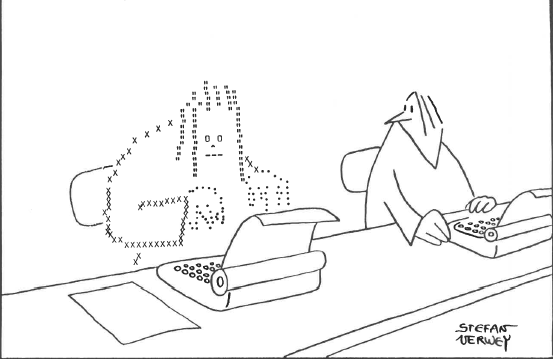
It doesn’t have to be this way. Were AI asked to run a trial comparing on one side a genuine consensus achieved between us and our doctors, with no one else in the room, as to whether we are having an adverse effect and to act appropriately, if we decide we are, and on the other side doctors sticking to and acting in accordance with labels and guidelines – which arm of the trial do you think would produce the better outcomes? Is there anyone who thinks the label arm would?
We live or die by the judgement calls, especially the genuinely shared judgement calls, we are allowed to make. Nowhere is this more true than in our polypharmacy times faced with a need to get off drugs liable to explode – with nothing in the labels or guidelines telling anyone how this might be done safely See God Does not Roll Dice.

It’s an obvious marketing scam isn’t it? The only surprising thing is that there are so few holding the system to account.
We all know good folk who anguish over the lack of UK Sunshine Legislation – when in the US it seems to have done little more than legitimise the greed of well known medical open handbags. Likewise, there are an awful lot of rows about the specifics of competing research methodologies etc. – when the fundamental issues are way up the food chain. The problem isn’t a few rotten apples, it’s a rotten barrel.
My impression is that one of the greatest facilitators of the scam is the poor research education of its primary target audience – doctors. When I was a bright eyed, little grad trainee in a research company, I was taught the works – questionnaire design, coding frames, powering studies to capture minority views or reactions, relevant stats etc. – and qualitative methodologies where my heart instantly lay. Far more interested in understanding why people felt, thought, acted as they did – than counting them. The big lesson I learned is that you can make quant research deliver almost anything you choose – and questionnaire design and powering are key to that. Qualitative – the stuff of whole humans – is far harder to distort.
As far as I can see – and I’ve done quite a lot of research with HCPs – doctors’ research education seems to begin and end with statistics. If it’s bigger it’s better, it’s more sciency. Numbers trump insights – which is crap because sometimes by far the most interesting findings lie in tiny clues.
This is why they’re so intoxicated by the frequency /prevalence nonsense – so evident in this post. Bigger init. Whereas- unless you’ve got a killer drug – commonsense would suggest that more people are likely to experience tolerable adverse effects than lethal ones. Though not so tolerable with SSRIs that 40% across studies don’t ditch the pills within 8 weeks because of intolerable adverse effects – notably, sexual, as well as vestibular and gut reactions.
I don’t see how the world ends here? It’s obvious we need an independent safety body drawing its evidence and insights from patients. To be fair (what!) , the MHRA is trying or trying to be seen to be trying to listen to patients – and actually did re SSRI suicide safety comms. But then they’ll have to argue the toss with umpteen MAHs so…
The FDA is your territory, not mine, but it doesn’t seem encouraging that two of the good guys, Drs Makary and Hoeg have got the push so quickly. As for ‘sainted Ian Hudson’- hmm – well, the Catholic Church, purveyors of sainthoods, have got form.
Let’s not Skip, Murgatroyd..
Let’s not Skip, Ian Hudson
Ian Hudson made-merry with his GSK deposition in 2001. When challenged by a Government Official at a meeting investigating Seroxat/Paroxetine, when Ian Hudson was not there. The old MHRA gave excuses for his absence, chief of which was Ian Hudson was excluded from meetings when Seroxat was discussed. All very embarrassing for MHRA, but none more so than his fiddling around with little children in his later life.
A Black Hole of Modernity
https://davidhealy.org/the-perfect-killing-machine/
‘Doctors, who are probably the best people to police the issue, look at someone like me like they are fit to kill. They don’t want to hear the message even one that is crucial to them staying in a job. If drugs work wonderfully well and are completely safe, we aren’t going to need the expensive pill-dispensing machines that most doctors have become.’
‘This is not a matter of holding someone to account – it’s a matter of getting honourable people to realise they can and should change the system.’
My own doctors looked and spoke to me, like ‘they are fit to kill.’
All I did was to present myself in front of them, practically daily. The annoyance was palpable, the words like dragons on fire. They went that way because no-one had told them any different, or not in a way that would dissuade their closed minds.
Today, it is all different as MODERNITY is prescribed.
Your Doctor can kill you, shooting-the-breeze. Stephen and people like him, went away, never to come back. The Killing Machine might offend, but it spells out the logic, that we all have in common. The strangers around us, went en masse, in their rudimentary way, that if we died by their hands, it really didn’t matter…
Psychiatry, psychiatrists, psychiatric drugs kill. This type of killing is protected by laws. There is nothing to bring forth the negative and biased counter-transference that is displaced onto and into one of their recipients. Progress notes follow legal safeguards, and the personal reflections and supervisor notes are not made available to the individual or general public.
It is possible 50:50, that the unconsciousness of many authorised prescribers, practitioners, harbour an unacknowledged dark side.
To drug people via experimentation, until the person is chemically (and biologically) modified into an abnormal representation of their true core essence comes with a side of indifference with more sides of ego-centric success. Should their play-thing break or die, no big deal, there are plenty more attachment substitutes.
‘We are crashing into AI.’
The Killing Machine, New Direction…
BC may use the courts to sue OpenAI over Tumbler Ridge shooting
https://www.msn.com/en-ca/news/canada/bc-may-use-the-courts-to-sue-openai-over-tumbler-ridge-shooting/ar-AA27mWAh?ocid=BingNewsSerp
VANCOUVER — The British Columbia government has hired lawyers in both B.C. and California to pursue legal action to hold OpenAI accountable for its part in the shooting that left eight victims dead in the northern community of Tumbler Ridge last February.
Attorney General Niki Sharma said Tuesday that no company or corporate leader should escape accountability when public safety is at stake.
“The province is preparing legal action to hold artificial intelligence company OpenAI and its decision makers accountable for their failure to notify law enforcement of the violent prompts made on its ChatGPT platform by the perpetrator prior to the tragedy in Tumbler Ridge,” Sharma said.
“The province is preparing legal action to hold artificial intelligence company OpenAI and its decision makers accountable for their failure to notify law enforcement of the violent prompts made on its ChatGPT platform by the perpetrator prior to the tragedy in Tumbler Ridge,” Sharma said.
The Mounties were working with specialized units and the Federal Bureau of Investigations to complete digital forensic analysis and investigative tasks, it said.
‘violent prompts’ – drugs, guns…