
BNPA stands for British Neuropsychiatry Association. I emailed its officers almost 4 months ago, about their annual meeting coming up in slightly over 4 months time.
This post goes hand in hand with Ariadne’s Thread on RxISK.
From: David Healy
Date: Fri, 3 Jul 2026 at 10:29
Subject: BNPA Meeting
To: Vaughan Bell, Ingrid Hoeritzauer
Dear Drs. Bell and Hoeritzauer
I’ve been approached by a patient who has a medication induced peripheral sensory nervous system disorder. She is concerned that a diagnosis of FND has slipped into her medical records. A growing number of patients, with medication triggered disorders that have a variety of sensory neuropathic elements in common, have similar concerns.
SSRIs are the common medication element. Acting on sensory receptors these can be of benefit but given in excessive doses and for too long they can disrupt sensory systems leading to disorders that in the absence of reliable tests, and perhaps given a background of nervous problems for which these drugs were given, can lead to the word functional slipping into the frame.
I’ve been writing about the effects of SSRIs on sensory receptors for some time and have several articles on these effects currently in press. Thinking about how misunderstandings arise at the intersection between SSRI related problems and FND diagnoses, it occurred to me that a BNPA meeting might be the best venue to start a conversation. Hence this note.
I’ve given two prior talks at BNPA meetings. I’m offering to give another focused on SSRI sensory system effects, which if misread risk alienating patients and generating pushback against the FND concept.
When a patient can take a hard-bristled brush and rub it up and down her genitals and feel nothing, and this clearly started with a drug and endured after stopping treatment, but she gets an ‘of course this is real for you’ message, it impacts on confidence in the medical system.
Beyond FND, the effects of SSRIs on sensory systems can shed light on complaints like Brain Fog and how, if you know what to look for, can support a Not Guilty by reason of Toxicity plea in legal settings. A lecture with a focus on sensory system effects, I hope might be of general interest but given an FND intersection I’d be more than open to BNPA having a linked FND talk and would share the articles mentioned and slides for the talk with whoever is involved in that aimed at making the session as fruitful as possible for everyone.
I hope to hear back from you at some point. David Healy
From: Ingrid Hoeritzauer
Date: Mon, 6 Jul 2026 at 08:22
Subject: Re: BNPA Meeting
To: David Healy, Vaughan Bell
Dear Prof Healy,
Thanks for your email and topic suggestion. We have already organised most of next years meeting as it’s the 40th anniversary of the BNPA and we are keen to celebrate that.
As you’ll know, the BNPA benefits from encouraging new speakers. We try to ensure that those you’ve spoken several times make way for new speakers so that the line up is always exciting and novel. It’s part of what brings back people year after year to the meeting and expands the learning for all of us.
We are sorry to turn your suggestion down and hope to see you in March next year at the 40th celebrations.
Kind Regards Ingrid
Images of Uncertainty

Images of Trauma was published over 30 years ago. The publishers insisted on a title change from Images of Uncertainty. Its early chapters dug into the prehistory of psychotherapy – mesmerism and hypnosis. Followed by the emergence of what we now view as psychotherapy in the work of Pierre Janet and Sigmund Freud with the uncertainty element cropping up when touching on the then Recovered Memories crisis of the 1990s.
Janet’s work was and remains very impressive. Unlike Freud, he did not switch from being an advocate of trauma as the cause of everything at one point and shortly afterwards to a view that trauma is irrelevant – it causes nothing. Janet focused on phenomena like dissociation and was the first ‘explorer’ of states like alien hand today that now would possibly support the concept of a functional neurological disorder (FND). He described experiments and reported results still viewed as valid today. He made no attempt to explain Civilization and its Discontents or The Future of an Illusion.
His work, however, did migrate into the science of crowd behavior, fashions and propaganda, as a recognition grew that just as with individuals crowds can be governed by the same dynamics he, and not Freud, had described.
Facing the images of uncertainty that clinical situations throw up and leaning more to Janet’s approach than Freud’s, it’s difficult not to accept that there is some validity to the concept of a functional neurological disorder (FND). The BNPA describe FND in flowery language that could well apply to a fashion (like Adult ADHD etc). They say there has been a “transformation in our understanding of functional neurological disorder during the history of neuropsychiatry – one of the most remarkable in the history of medicine”.
We unquestionably from time to time display unintended and not readily explained automatic behaviors. Some of these we can now link to Tourettism (not the same as saying you have Tourette’s Syndrome), some are linked to Narcolepsy, Parasomnias linked to the stages of sleep, others to epileptiform conditions, and some to catatonia, the most dramatic and seemingly willful of all, despite us viewing it as involuntary.
These states generally can be triggered or aggravated by any one of the following – physical illnesses, medication or emotional shocks. There can be real problems working out where the boundaries of any of these states begin and end. Is neuroleptic malignant syndrome part of catatonia? Should serotonin syndrome be viewed as part of catatonia? When conditions like PSSD, or similar conditions after finasteride, or isotretinoin, or related states after mefloquine and many anticonvulsants, endure for years after treatment stops has the problem become a functional one – a psychological one?
The word functional is a weasel word. Catatonia is a disorder of function but is clearly not a psychological problem in the sense of a neurosis or something ‘put-on’ as we loosely understand those words – See Feedback Loop Disorders.
If catatonia and tardive dyskinesia and diabetes are not FND – all can be made worse by stress – what exactly is FND?. (Diabetes up to 1920 was viewed by many doctors as a form of male hysteria – see Are Diabetes and Depression Linked). Does FND or does it not involve automatisms – reflex unintended behaviors? Are its behaviors to some extent intended unlike those of automatisms?
These are not easy matters to settle. But there comes a point when some degree of settling is needed. We have got to that point when people taking SSRIs end up with PSSD or Visual Snow Syndrome or Persistent Postural Perceptual Dizziness (PPPD) are told they have FND – without anyone doing the tests supposedly specific for FND. We have got to that point when people PSSD, VSS or PPPD get referred for psychotherapy – aka trauma therapy – for their FND. We have got to that point when they get put on SSRIs, which unrecognized by their doctors have caused the original problem, in order to manage the person’s anxiety which according to the doctor is manifesting as FND.
We have got to that point when FND enters a person’s medical record and they can’t get it removed and everyone, either consciously or unconsciously knows that FND in a medical record is a kiss of death and nothing this person says about their symptoms is ever likely to be taken seriously again. Functional can be and has become for many a toxic word. We have got to a point where something needs doing.
Reclaiming FND
This is not all the fault of the originators of modern day FND. The concept sits on a slippery slope between Janet and Freud. While the label may be applied by some neurologist in a specific sense to a specific patient, once let loose in the wider world and exposed to the fertilizing interests of many varied health system stakeholders, its growth always risked taking off.
While the great harm these developments can do is not all of the fault of the originators, they are in a better place than anyone else to put a brake on things – if only to save their baby. Otherwise, FND risks going the way of medically unexplained symptoms (MUS), somatization, illness behavior and other initially helpful framings of important points, which end up being viewed as ‘hysteria’ in disguise and abandoned as pejorative.
A key thing is to ensure FND does not get diagnosed until the diagnostician has ruled out the possibility of a prior drug induced toxic state. This may not be easy as we have a culture that rushes to embrace new diagnostic fashions like FND, adult ADHD and adult ASD but flees possible diagnoses of treatment induced problems – such as toxic physical states in response to medicines or toxic psychological states such as recovered memories of abuse that never happened.
We are quick to blame patients for failing to recognize the illnesses they have – saying they have an additional condition we call anosognosia (although this is a drastic misuse of that word) but we are glacially slow to recognize professional Venomagnosia – See Horrendous Investigations.
Although dressed in scientific jargon such as anosognosia, these are indecent manifestations of defenses against science rather than ‘decent’ contributions to science or clinical care.
A central point that needs nailing down that MHRA last week – MHRA Warnings – were dragged toward recognizing is that many bizarre conditions can continue for years, even decades, after the triggering drug is out of the patient’s system.
It was semi-understandable that some doctors would ridicule people for thinking a drug they had been off for a year or more could be causing a real physical problem – this had to be something functional. There were similar initial responses to Tardive Dyskinesia.
Neurologists are not just in appropriately branding people who have real and serious problems, they are passing up a chance to make neurological discoveries by not taking seriously what people tell them in good faith. Discoveries linked to drugs they use like anticonvulsants. Anticonvulsants cause real problems that can endure for years after stopping. Exploring what is happening could help patients, make a neurologist’s job more exciting and lead to scientific breakthroughs.
In clinical trials, anticonvulsants double the rate of suicidal events compared to placebo and likely homicidal events but the timeframe differs from the increases in suicidal events on antipsychotics and suicidal events on antidepressants. Why? The mechanisms linking antidepressants and antipsychotics to suicides and homicides are well worked out – is there any input from neurologists as to how anticonvulsants ends up causing effects like these?
Science is empirical. This means that like law it is about observing what happens in front of a jury aimed at coming to a consensus – a diagnosis or verdict. The jury members who have equal weight when it comes a consensus. We who have the problem should not feel under any onus to defer to the ‘beliefs’ of a doctor. The onus is on doctors to keep a door open to their beliefs being wrong.
Decency requires not entering into a patient’s record a label on which doctor and patient have not arrived at a consensus – or at the very least making it very clear in the record the patient does not accept the doctor’s view.
Warning
I had been warned that any attempt to raise concerns about FND would be attached as misguided and anti-patient. Attacked in terms similar to accusations of transphobia or Adult ADHD-phobia. All is fair apparently in Love and War but also these days in identify battles.
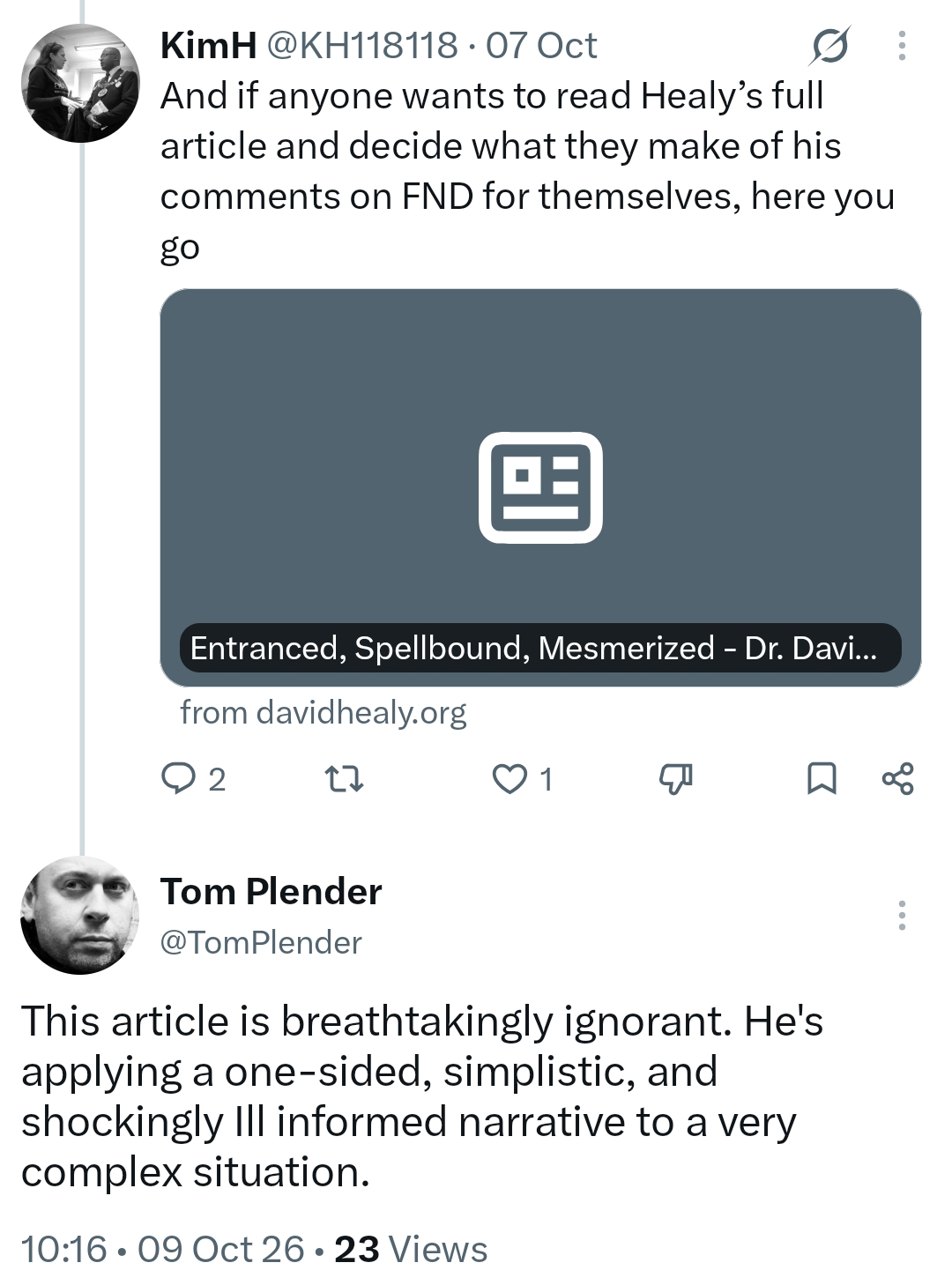
The response in the image here and comments below has happened to others questioning FND. This again is something that medical supporters of the FND concept need to take stock of.
One could write a book about DIND – Drug-Induced Neurological Disorders
https://pubengine2.s3.eu-central-1.amazonaws.com/preview/99.110005/9781616764258_preview.pdf
Good point
D
Recognising and explaining functional neurological disorder
Marion Brown
Retired
Stevie Lewis, Alyne Duthie, Fiona French, Sharron Hudson, Beverley Thomson, Ann Kelly, Janette Robb, Dierdre Doherty
(Voice of Patient research group)
UK
https://www.bmj.com/content/371/bmj.m3745/rr
In April 2018 we wrote ‘Is the BMJ – and the medical profession that it represents – really ‘listening to patients’ and the public?’ (12) “..it is becoming abundantly clear that ‘the evidence’ of prescribed harm is being actively attributed to vague psychiatric diagnoses such as ‘medically unexplained’, ‘functional’ and ‘somatic’ disorders. Patients suffering complex, serious and disabling symptoms – from prescribed drug damage and neurotoxicity – are being directed to websites such as http://www.neurosymptoms.org/ and encouraged to engage in Cognitive Behavioural Therapy (CBT) and acceptance of their mysteriously acquired disability. There is emphasis on locating problems in the patients’ own early life experiences – and socio-economic circumstances – without any reference whatsoever to the all-important life-time ‘medication history’ and its own trail of havoc in the life and health of the patient.”
Our Public Petition ‘Patient Voice’ evidence was included in the Public Health England Review (3) and features in the ‘Patient evidence’ for the National Guideline Centre (13). In their petition evidence, a number of patients (25%) describe MUS or FND diagnoses following antidepressant adverse effects.
If patients ask their GPs or neurologists about the possible cause of their acquired symptoms and disabilities, any suggestion of a link to the ‘effects of medicines, taken as prescribed’ is usually strongly denied, and the patient’s ‘beliefs’ called into question. This, of course, adds further to their distress.
One of the issues I have is that my wife and I know plenty of people whose FND seems almost transparently performative, but we know a much smaller group of others whose symptoms make you seriously question the EEG results. That these two groups are distinct is clear to us. The only thing they seem to have in common is that they’re emotionally upset, and this is read as borderline.
It sounds like an odd thing to claim, but this is one area where I’ve always been struck by the sense that there is both a genuine article and a counterfeit, and some people can spot the difference and some people can’t. The idea that there are two “hysterias”, a histrionic-hysteria and a hystero-epilepsy, and that the two are not the same thing, is not new. It seems preposterous that God or Mother Nature would create two such similar conditions, but I feel almost frog-marched to this conclusion by the evidence of my own eyes.
One possibility is that Gunderson’s borderline criteria simply describe behaviours common to chronic emotional instability. Since there would logically be many ways into a state of emotional upset, the stage is set for particularly extraordinary mimicry among syndromes involving emotional dysregulation.
I’m not sure anyone will understand this – I’m not sure I understand. No one has read Gunderson for a long time.
Are you saying psychotropic drugs acting on very basis sensory and reflex processes can give rise to feelings (sensations) and emotions (sensations priming actions) and many of these are pretty primitive but we have to make sense of what we are sensing – and this leads to valid if not necessarily fully accurate reports that run smack into the cognitive dissonance of a doctor and gives him a functional problem – he becomes hysterically defended against the idea that he has or might be suspected of having harmed someone when everything that happened was done by him or a colleague with good intentions?
D
You’re underestimating Gunderson’s fame. He’s one of those household names in my service. Maybe not everyoneknows his name but I’d say he’s up there, BPD is a huge deal.
I’m saying the answers might be more mundane. I’m saying there might be a lot more heterogeneity than we realise. Some diseases attract hypochondriacs. Make emotional instability a cardinal symptom and your sample will be overrun with the worried well.
FND isn’t far off this sort of thing. Some cases look fake, others look real, what if its that simple? Mix the two, and the real signal is drowned out.
You sure there isn’t a timewarp here that Melbourne is caught in I haven’t heard anyone mention Gunderson for at least 35 years or so before your comment. I imagine few if any readers here will have heard of him. He has a very readable book on Borderline Personality – aka as Hysteria.
But he is pre-SSRI and so to some extent has to be pre the issues we are dealing with here. I’m not clear if there is any indication he was ever aware of the possibilities that these drugs might shift people along personality axes and if he wasn’t, then anything he says needs reinterpreting in our circumstances today.
The indications are that by muting sensory inputs SSRIs shift us along personality axes. Our sensations drive our reflexes, which shaped by habits form our personalities. Introverts feel flooded by too much sensory input and try to manage this often by ending up indecisive. SSRIs by muting some of that input seem to let priorities for action become more salient and by feeling (sensing) less obsessives sense (feel) not only cured but better than well in many cases. I’d much prefer to be like this the whole time.
But extraverts more prone than introverts to act reflexly, to take action (risks) rather than manage it, may become even more so if sensory inputs that might get them to pause and reflect are even more likely to be impulsive (borderline – hysterical).
All of this is pretty simple and hard to argue with. It gets interesting if you throw withdrawal into the mix. I’ve seen many normal people (pre-treatment not especially introverted or extraverted) shift into being introverts they never were before on stopping not just SSRIs but also antipsychotics – I’ve had lots of reports that she/he is now overthinking in a way s/he never did before. Why? Well, one of the factors has to be that not just is sensing now unmuted but there are a ton more novel sensations the whole time linked to withdrawal (protracted withdrawal is the real killer) and even if you weren’t inclined to take every new sensation account before there are so many now and some of them pretty weird so you get pushed into figuring it all out mode and making sure you have things write.
What I think you’re raising is what happens to extraverts when they stop the meds? You might think that restoring full sensation would make them less borderline but its not just restoring full sensation its adding a bunch of extras into the mix – so do they become better than well – more stable than ever before. Doesn’t look like it. Maybe perhaps because they’re more likely to have stopped things like anticonvulsants or antipsychotics than SSRIs.
These are things we desperately need to get a handle on – that we can only get by looking at and listening to people Gunderson never encountered
D
Yes, I’ve got Gunderson’s book. It’s quite a good book, certainly the best on the subject. I think his operational criteria are quite unremarkable, though. There is no time warp in Melbourne. BPD is the king of secondary psychiatric diagnoses, so if ADHD is all the rage in private community clinics, in the public mental health sector, BPD is our ADHD. Consequently, there’s an endless parade of seminars, workshops and meetings with advocacy groups. It’s not the least bit unusual to hear John Gunderson mentioned, typically alongside Marsha Linehan. Most of the learning materials are based on their respective work.
Gunderson also happens to remain one of the more popular clinicians in online spaces, even posthumously, not least because BPD itself is such a popular diagnosis in these spaces, despite the stigma. I think it’s largely because, these days, he and Linehan are promoted by advocacy groups, some of which are basically DBT cultists. I suppose they need figureheads and symbols and having a patron saint clinician seems to be a popular choice among these movements.
I agree with everything you’re saying. I’m just pointing out that a lot of mothers tell me these doctors aren’t having a very good look, so I’m not sure we need to resort to psychodynamics to explain what might be a drunk looking for his keys under a lamppost. How often are women told they don’t have endometriosis, only to take matters into their own hands and, lo and behold, discover that they had it all along? Sometimes the explanation may be rather more prosaic than we’re inclined to imagine.
I suppose you might argue that reflexes and personality are themselves prosaic explanations, which they are. But what I’m getting at is that if it waddles like endometriosis and quacks like endometriosis, perhaps it really is endometriosis. By which I mean, perhaps some of these women really do have ataxia, mesial temporal lobe epilepsy or some other neurological condition, but because the doctors have already decided “it can’t be that”, they fail to find it.
I mean, if a surgeon can put a mitral valve in upside down, open the poor young lady up a further four times and still miss it because everyone thinks “it can’t possibly be that”, what else can people fail to see simply because they’ve already decided what it can’t possibly be? Doctors can be remarkably bad at finding things they don’t believe are there. And how hard are they even going to look if they’ve already ruled out the possibility in their own minds?
The reason I’m saying this is that there’s a familiar pattern in women’s health. For years, a woman will say, “I really think it’s X”, only to be told, “No, it can’t possibly be X.” Then, after twenty years of exasperation, she finally pays thousands of dollars out of pocket for some investigation that reveals it was exactly what she said it was the entire time. Women have a funny way of knowing what’s going on in their own bodies. I’m not saying they’re always right, of course, but you know the sort of thing I mean..
I can’t help but think of PSSD here. After all the song and dance about how there couldn’t possibly be actual neuropathy, lo and behold, we start getting reports of small fibre neuropathy in patients with PSSD. Then, a little later, Goldstein comes along reporting actual tissue abnormalities.
As my wife likes to say when I can’t find my coat, “Did you have a boys’ look or a girls’ look?”
You’re missing the point – perhaps because I need to pull the key issues in one place at some point.
SSRIs mute sensory inputs which affect all reflexes – including habitual facial expressions and habitual body language – personality and patients in mental health units and prisoners in prison as well as families and friends can spot when someone is put on one – and also spot when they are not leaving the person serene but creating an irritability that also changes personality. This is how SSRI were discovered.
I’m not sure what prosaic means above but reflexes and personality are pretty solid and can predict how much of a drug is needed to put you to sleep for surgery for instance.
I’ve referenced Gunderson 30+ years ago but I’ve never heard anyone mention him for 35 years or more. We ran a DBT trial in N Wales – it didn’t work. Partly because the things it suggests doing were being done here anyway for a decade prior to the trial – nothing to do with Linehan – so it couldn’t beat placebo.
The simple point is no-one – in Melbourne or anyone else – is looking at observations or listening to people reporting things that came onstream with spades and anticonvulsants and trying to draw lessons from this and if they are citing Gunderson and Linehan they are even more likely to be missing what is front of them
D
Perhaps I can share this …. From 2021.
Transcript: Marion Brown Question (1.16) & Vaughan Bell Answer
Maudsley Philosophy Group Webinar 9 Sept 2021
The organic-functional distinction in psychiatry and neurology – Vaughn Bell | Seminar 1 Autumn 2021 – YouTube
Paper discussed: What is the functional/organic distinction actually doing in psychiatry and neurology? – PMC (nih.gov)
Quinton (Chair): Marion Brown, I see you have a hand raised. Would you like to contribute?
Marion: Yes, sorry, I’m coming from sort of outsider’s perspective. I’ve written quite a few articles now about patient experience. And I know a lot of people who have become diagnosed with functional neurological disorder over the years, and more recently. And their history, speaking about the aetiology, their history has been that they’ve been on antidepressants or benzos and been trying to come off of them and have run into terrible problems, trying to come off their medications. Actually the functional… it is that the nervous system not working.. so, I mean, it’s like not working anymore. So the ‘functional’ is probably a fair enough term. But the feeling is that It’s being misdiagnosed as a psychological problem, or a psychiatric problem. So there’s more drugs being thrown at them. And so what’s happening is sort of that the whole nervous system is being messed up. The role of the psychiatric drugs, and especially antidepressants – which are largely seen to be safe and effective – seems to be being missed. And as Vaughan said there is very little evidence of patient experience and we’ve been collecting patient experience. We’ve had a petition in Scotland and a petition in Wales collecting evidence, which we’ve now written up, so really can I say, please look at this? So what’s happening is like, you know, that the nervous system is being left in an unstable state. So it isn’t functioning, you know, people are suffering functional problems. So the wiring is messed up, is I think, what we’re trying to say. So really what I’m saying is please can we not overlook the effects of the CNS drugs which have been used for psychological or psychiatric problems?
Vaughan: No, really important point, actually. And I think, you know, when we’re talking about these sociological issues of what gets ascribed function organic, based on you know, kind of what people think is most convenient, I don’t mean that is a or trivial sense, often very well intentioned, you know, I think this kind of whole area of, you know, problems caused by medication or the treatment and the difficulties they lead on and the extent to which they’re interpreted as functional or organic you know, how our complaints understood in that particular arena, and that’s barely been investigated, actually, that’s probably a very fruitful avenue to look down.
Marion: Thank you
Quinton: Thank you very much, Marion, for that comment.
In Canada, there is a mass tort against the government of Canada over the misuse of Mefloquine in Military applications. The law firms Howie Sacks and Henry along with Phillips Barristers are the legal team. I was the Representative Plaintiff for the Class Action, which then morphed into the mass tort action.
John
It would be good to hear more about this – especially linked to the Ariadne’s Thread post on RxISK.org
David
X Thread by Kim Hearne. (FND Action uk)
28 Oct 2026👇
Healy is entitled to present case studies, explore medication harms and question clinical decisions. But why does this repeatedly turn into sweeping statements about FND, we ask ourselves, without involving specialists? An inability to collaborate? 1/12
Anyway, he raises concerns about patients allegedly being misdiagnosed with FND following SSRI exposure. But has he established this? What positive clinical signs were identified? Were the diagnoses overturned? What clinical evidence established an alternative? 2/12
Healy acknowledges some validity to FND, yet calls “functional” a weasel word. So what does he propose we call neurological symptoms arising from disrupted functioning rather than structural damage or disease? Dismissing the terminology doesn’t explain the clinical findings. 3/12
And describing FND appearing in medical records as a “kiss of death”? What an awful choice of words about a diagnosis already burdened by unwarranted stigma. How does reinforcing that stigma help patients genuinely living with FND? Or don’t they matter? 4/12
Furthermore, what about patients who actually have FND? Those with distinctive positive clinical signs, incl. people who’ve never taken SSRIs. How do their neurological presentations fit into his argument? Why are they always absent from debates questioning their diagnosis? 5/12
And what about those prescribed SSRIs only AFTER developing FND? Or those who’ve never taken them at all? SSRI exposure cannot explain neurological symptoms that preceded it. These patients exist and can’t simply be excluded from sweeping statements. That’s just foolish. 6/12
Healy proposes ruling out drug-induced toxicity before diagnosing FND. Isn’t medication history already part of neurological assessment? If toxicity is proposed as an alternative explanation, what findings distinguish it from positive FND signs? Where’s the evidence? 7/12
And why assume medication exposure means FND is a misdiagnosis? Physical events can precede FND onset, with drug reactions reported among possible precipitants. Could medication-related events trigger genuine FND in some cases? That possibility deserves investigation too. 8/12
Healy suggests patients should agree to a diagnosis before it’s recorded, or have their disagreement documented. Patients have every right to question a dx. But not accepting one doesn’t automatically make it wrong. Clinical findings don’t disappear because a dx is disputed. 9/12
And can we please get over Freud and hysteria? It’s 2026! Patients with these neurological presentations have faced centuries of dismissal. Modern FND diagnosis uses positive clinical signs. Why keep dragging patients back into history instead of examining today’s evidence? 10/12
We see allegations involving #mecfs. Now it’s medication harms. Tomorrow, #LongCovid? Different patient populations yet FND repeatedly becomes the alleged diagnostic mistake. FND can’t be the misdiagnosis of everything. Where’s the clinical evidence establishing the errors? 11/12
I’ve asked more clinical questions than Healy’s article attempts to answer. Why keep recycling assumptions about FND instead of investigating them? Clinical politics? An inability to move beyond its history? Whatever the reason patients are collateral damage and that stinks 12/12
Kim is co-founder of FND Action uk.
Who We Are – FND Action https://share.google/STidVMSUPBr5qSVvh
Marion
I’ll try to separate responses to the conveniently listed various points here.
Point 1 Healy is entitled to present case studies, explore medication harms and question clinical decisions. But why does this repeatedly turn into sweeping statements about FND, we ask ourselves, without involving specialists? An inability to collaborate? 1/12
The patient whose predicament set up my email to BNPA was diagnosed by 2 neurologists with FND without any specific tests. They seemed decent men but refused her reasonable request to delete FND from her record and to engage with my enquiries on this point. The message was we know what we are doing – when they don’t know what they are doing when it comes to PSSD. PSSD is a multisystem disorder involving eyes, balance, muscles, sex, and other signs and symptoms as well. These neurologists don’t know its boundaries, didn’t show any interest in asking me about its possible extent, or features that might have misled them to an FND diagnosis. FND for them seemed to boil down to this patient is anxious and her anxiety is causing her to make mistake. They showed no interest to engage in a dialogue – and it was this that led to my approach to BNPA.
That was several months ago. Yesterday, I wrote a report for a woman where an insurance company was arguing that her prior record of functional and personality difficulties cast doubt on her view that her medicine had caused her PSSD. Her medical record was appalling list of abusive FND and FND ballpark diagnoses. This is typical of what happens to people with PSSD, even those seen in eminent specialists centers.
In line with the prior history of FND type diagnoses, this is typical in particular of what happens to women in these situations and has been happening from Freud onwards. Women have even been detained and prescribed antipsychotics for their ‘crazy’ ideas.
Point 2 Anyway, he raises concerns about patients allegedly being misdiagnosed with FND following SSRI exposure. But has he established this? What positive clinical signs were identified? Were the diagnoses overturned? What clinical evidence established an alternative? 2/12
See answer to 1. PSSD is an unequivocal diagnosis – there is no other condition in medicine apart from one rare genetic disorder that produces anything similar. There are now tests that demonstrate the physical changes.
But the key question for Kim – is why does she and other neurologists not believe people – especially women – when they outline their symptoms Even if this is something a doctor has not met before, something that is not in the books, why not believe your patient?
Science is based on observations. Every giving of a prescription medicine is a scientific experiment – the results are likely to differ in important respects from person to person and the key observations in the scientific experiment that is prescribing for this person are her observations. Why not believe her?
Is there an FND alternative for a person with PSSD.
There responses need to be read from Response/Point 1 through to 12
Point 3 Healy acknowledges some validity to FND, yet calls “functional” a weasel word. So what does he propose we call neurological symptoms arising from disrupted functioning rather than structural damage or disease? Dismissing the terminology doesn’t explain the clinical findings. 3/12
For at least 6 decades or likely more we have assessed children for recurrent abdominal pains and diagnosed them as functional – and some of these children, even aged 10 or so can detect that functional means their pain is arising from a stressed home situation, perhaps copying a parent, rather than from a serious organic situation.
Functional has been a weasel word for a long time. Before they found the word functional, neurologists were liable to call the problems supra-tentorial. It’s a pity they didn’t find something better for FND.
Point 4 And describing FND appearing in medical records as a “kiss of death”? What an awful choice of words about a diagnosis already burdened by unwarranted stigma. How does reinforcing that stigma help patients genuinely living with FND? Or don’t they matter? 4/12
The stigma has been brought on by those using it. There are growing numbers of people pushing back against this diagnosis. By alerting neurologists to the need to stress that FND should not be diagnosed in cases where there is prior evidence of possible toxic exposure, I’m trying to save some space for this concept.
You’re shooting a potential friend here.
Point 5 Furthermore, what about patients who actually have FND? Those with distinctive positive clinical signs, incl. people who’ve never taken SSRIs. How do their neurological presentations fit into his argument? Why are they always absent from debates questioning their diagnosis? 5/12
I’ve left the door open to there being a real condition appropriately called FND but having asked Jon Stone in person about this several years ago, my sense then and still now is that the concept has some unresolved incoherencies.
D
Ideally read these responses from responses 1 and 2 in sequence.
Point 6 And what about those prescribed SSRIs only AFTER developing FND? Or those who’ve never taken them at all? SSRI exposure cannot explain neurological symptoms that preceded it. These patients exist and can’t simply be excluded from sweeping statements. That’s just foolish. 6/12
I’ve no idea where you get this idea. I haven’t brought this into the frame.
Point 7 Healy proposes ruling out drug-induced toxicity before diagnosing FND. Isn’t medication history already part of neurological assessment? If toxicity is proposed as an alternative explanation, what findings distinguish it from positive FND signs? Where’s the evidence? 7/12
I wish it weren’t true but I have yet to meet a neurologist who has any sense that the medicines they use, never mind others they don’t, can cause toxic effects. This is the speciality that has tolerated 50 years of valproate toxicity and related toxicities from other anticonvulsants without making much of a contribution to our understanding of it.
Point 8 And why assume medication exposure means FND is a misdiagnosis? Physical events can precede FND onset, with drug reactions reported among possible precipitants. Could medication-related events trigger genuine FND in some cases? That possibility deserves investigation too. 8/12
The onus here is on FNDers to demonstrate how drug induced toxicity gives rise to FND. They haven’t don’t so to date. Drugs induce catatonia – a functional state – but catatonia is not, as far as I can make out, an instance of FND. Can you specify where FND and catatonia differ?
Point 9 Healy suggests patients should agree to a diagnosis before it’s recorded, or have their disagreement documented. Patients have every right to question a dx. But not accepting one doesn’t automatically make it wrong. Clinical findings don’t disappear because a dx is disputed. 9/12
We are talking about decency. Where an increasingly stigmatizing diagnosis is being proposed, those who will be branded need consulting and probably should not be diagnosed without their consent.
Point 10 And can we please get over Freud and hysteria? It’s 2026! Patients with these neurological presentations have faced centuries of dismissal. Modern FND diagnosis uses positive clinical signs. Why keep dragging patients back into history instead of examining today’s evidence? 10/12
The post stresses that there is room to think there are conditions appropriately diagnosed as FND but in practice many people given an FND diagnosis get referred for therapy – trauma therapy. I agree this means they are being dismissed but the onus is on FND-ologists to take this into account and put a stop to it. The onus is not on me
Are you guys going to take any responsibility for the consequences of what you are doing – are do you think that your good intentions absolve you or all responsibility?
Modern day patients are being diagnosed on the basis of being anxious by neurologists who have video interviewed them and not elicited any positive clinical signs
Point 11 We see allegations involving #mecfs. Now it’s medication harms. Tomorrow, #LongCovid? Different patient populations yet FND repeatedly becomes the alleged diagnostic mistake. FND can’t be the misdiagnosis of everything. Where’s the clinical evidence establishing the errors? 11/12
See Point 1 above. With PSSD – there is an obvious error
Point 12 I’ve asked more clinical questions than Healy’s article attempts to answer. Why keep recycling assumptions about FND instead of investigating them? Clinical politics? An inability to move beyond its history? Whatever the reason patients are collateral damage and that stinks 12/12
As has been often said, those who fail to take history into account are doomed to repeat it
D
I was prescribed an SSRI for lack of sleep (causing anxiety/upset). Within a week of taking the drug I had tinnitus, ED, complete memory loss, full body rash, tongue sores, emotional numbness, cognitive decline, uncontrollable shaking, full body numbness & more.I remained in a non functional state for nearly two years.
I learned later that tests exist for SSRI toxicity.
The tests should be required before prescription.
I miraculously came back to life, mostly intact.
Where is the accountability for this?
Listen to this comparison-As a builder, I’m liable for 5 years for any construction defects!
M
There are no tests to reliably predict SSRI toxicity. The real question though is why would your doctor not believe you – I’m guessing from the tone of your note that they didn’t believe you. The answer is partly because companies claim their controlled trials show their SSRIs have ‘no’ side effects. Most doctors faced with claims like this buckle under them and accept in order to avoid trouble for themselves that the problem must be something in you.
This is where being able to give you a diagnosis of FND comes in handy.
D
I have visual snow syndrome from ssri lost my job can’t drive where is the liability? Nothing functional about permanent Visual damage.
Natalie
There’s nothing functional at all – but in the absence of demonstrable eye or brain changes lots of neurologists and ophthalmologists may diagnose you with FND, which for many, perhaps not those who give your the label, will mean the problem is in your mind rather than caused by the drug.
Your VSS is a damage. Getting an FND diagnosis can also be damaging. Asking who is liable for your VSS is an important question – arguably pharmaceutical companies. This post is asking who is responsible for your FND diagnosis if this diagnosis has entered your record in a situation like yours.
D
This apparently is Kim Hearns. It’s a considerable irony to find her attacking the voices of people who object to being branded with FND.
FND: the patient’s voice
Kim Hearne
Abstract
Kim Hearne is the CEO and founder of FND Action, and an advocate for those living with Functional Neurological Disorder (FND). As someone personally affected by FND, she brings a unique perspective, using her own experience to drive awareness, support, and change for the community. Through FND Action, Kim works to amplify patient voices, challenge stigma, and improve access to care. Her passion and dedication make her a powerful advocate for those navigating life with FND.
Functional Neurological Disorder (FND) is a common but widely misunderstood condition, often leaving those affected feeling unheard, misdiagnosed, and unsupported. Despite being one of the most frequent reasons for referral to neurology, FND patients face significant barriers in accessing appropriate care, battling stigma, and securing recognition for their condition.
This presentation will shed light on the lived experiences of individuals with FND, highlighting the challenges they face in the medical system and beyond. Many struggle for years to receive a diagnosis, only to find that treatment pathways are unclear, inconsistent, or even unavailable. The historical stigma surrounding FND – often dismissed as psychological or ‘not real’ – continues to impact the way patients are treated by medical professionals, employers, and even friends and family. This lack of understanding can lead to frustration, isolation, and worsening health outcomes.
By centring patient voices, this presentation will explore the real-world impact of FND, from the emotional toll of feeling disbelieved to the practical difficulties of managing symptoms in daily life. It will also highlight the power of advocacy, peer support, and education in shifting perceptions and improving the future of FND care.
Patients are the experts in their own experiences, and their voices must be heard to bring about meaningful change. By amplifying their experiences, we must all challenge misconceptions, promote better healthcare practices, and work toward a future where those with FND are respected, supported, and given the care they deserve.
See Image added to the end of the Post above
There is a terrible mismatch between the expectations of iatrogenically harmed patients and neurologists. Naively, we assume neurologists will know what’s gone wrong and how to fix it. But I have yet to meet a neurologist who has any sense that the medicines they use and others can cause toxic effects.’
My first encounter with neurology on behalf of a patient went like this:
Neurologist: ‘It’s really most unlikely that medication could have caused this’.
Me: (Thinks – crikey, I’ve got a right one here). ‘How can you be so certain that this is not drug-induced, especially in view of the patient’s history and the precise coincidence of these symptoms with the timing of prescribed medication?’
His hunch was some sort of Encephalitis. Not unreasonable – if you ignore the history. Nope, that didn’t seem to matter.
Next came a battery of obscure tests and scans, after which this extremely bright and sympathetic neurologist- finding no sign of the lurking remnants of Encephalitis had to conclude that – the adverse effects of medication could not be completely ruled out – but then he wasn’t a neurotoxicologist.
We went through various other neurologists and misdiagnoses – bizarrely disconnected from the human being in front of them. Primary autism – what, for a guy who was the most socially and emotionally connected human being on the planet from birth -until he had the misfortune to enlist medical help?
FND – he appeared to be able to understand the spoken instructions for neuropsych tests, even though he underperformed massively on them vs past abilities.. Can you not understand the significance of this result – it means that some aspects of cognition are working and other aspects are not. This is a finding, not something to be buried under ‘feck knows what the diagnosis’ is.
Quite a few good friends in the prescribed harm community are convinced that FND is being used as a cover-up for medication harms. Given the frequency and consistency with which those struggling with benzodiazepine induced neurological dysfunction (BIND) and the very obvious toxic effects of SSRIs notably PSSD, tremor, brain fog etc., are given this diagnosis, it’s hard not to agree with or, at the very least, understand this perspective.
Yet, there is also an extraordfinary level of ignorance about neurotoxicity amongst neurologists.. One delightful physician said to me, ‘the problem is there’s no research’. Um, yes there is – and if I know it, why don’t you?
In a quest for knowledge, Marion and I have often turned up the same papers. For example, ‘Drug induced disorders of the nervous system’ (2007):
‘Drug-induced neurological disorders (DINDs) are important because early recognition and drug withdrawal can prevent irreversible damage. This review deals specifically with the recognised neurological complications of prescription-only, single-agent therapy, either at recommended doses or in excess and summarises the more important DINDs’
https://www.researchgate.net/publication/6339422_Drug-induced_disorders_of_the_nervous_system
What are the important DINDS analysed? The conditions harmed patients have consistently identified for years. Seizure-like episodes (shaking, blackouts, or loss of awareness) not caused by abnormal brain electrics, sensory symptoms (numbness, tingling, visual disturbances, hearing loss etc.), cognitive issues (brain fog), movement disorders. severe neurological fatigue, dizziness, and chronic pain – these all overlap with symptoms that lead to FND diagnoses.
I can well believe that functional neurological disorders are real – and can occur in the absence of drugs and chemicals. But, the fact that many of those diagnosed with FND are taking rx drugs, with notable upweights to antidepressants and polypharmacy vs controls, should make anyone with half a brain question at the off, ‘what role could medication have played in this presentation.
From Facebook Paul P
I came off prozac cold turkey in September 2007 as I was told by my Gp that it was safe to do that .
I have suffered an extreme and unimaginable amount of neurological symptoms ever since.
The type of torture that can only be known by others who have also suffered the same fate from psych drug damage.
I was diagnosed with FND by a neurologist 3 years ago in n November 2023.
I have just been treated like all my symptoms are mental health and never offered any help or treatments.
FND diagnosis is a deliberate way to shut up patients who are extremely damaged by antidepressants and other psych drugs.
And blame the patient instead of admitting it’s the psych drugs that cause terrible nervous system and brain damage.
The neurologist even argued with me saying that psychiatric drugs don’t cause extreme and long lasting or permanent neurological damage.
It is gaslighting in the extreme for people like me . I have never recovered in 19 years. Despite stopping the Prozac in 2013 completely and never taking anything since .Not even any alcohol or definitely not any prescription drugs at all . Just nothing at all since then .
From Facebook Toni H
Some neurologists know ! I had two of them put it in writing for me that of no doubt antidepressants were the cause . Getting validation however doesn’t help matters at all . The damage is still done .
From Facebook Dunja G
Thank you for addressing this issue! This is my experience, that many of the people I’ve met who have sought help for neurological problems post psych drugs and ECT are being diagnosed with FND. In my opinion it’s a way of (unintentionally?) covering up for the damage caused by psychiatric treatments.
From Facebook Jean M
FND is a label for practitioners to use since they can’t directly say med injury/drug induced neurological disorder. (Pssd, vss, etc.)
From Facebook Helena B
I was first diagnosed with fibromyalgia and then later with FND and I have absolutely no doubt my symptoms were caused by the psych drugs- this was denied to my face tho by the neurologist who diagnosed me with FND. “You can’t prove it” he said and there is our main problem. Proof. I’m in a few online FND groups and since the covid jabs we have been flooded with new cases especially teenagers; I believe it to all be iatrogenic brain damage. Of course doctors don’t want to acknowledge that! Kudos to you for trying.
From Facebook Eve K
The fibro for me was definitely caused by benzos (and most likely the pill) as a teenager and I’ve had it since I was 19. Took me until 40 to be diagnosed and even then they blamed childhood trauma. They threw every drug in the book at me. Ended up on 13. Got worse and worse. Getting clean fasting coffee enemas and a ton of vagus nerve work and other body type therapies have kept me alive. Also known as CFS ME FND long Covid, it’s all the same thing and it’s utterly disabling and soul destroying due to its waxing and waning of symptoms. I’m so sorry you have experienced the same. I only got the FND diagnosis trying to get benefits as I’m broke and the U.K. government have told me instead I’m well enough to work.
On X Emma M
Could FND be caused by long term use of anti convulsants?
E
Anticonvulsants cause real physical problems that need real solutions that will only come from accepting the problems are real and investigating their physical basis. Labelling these states FND is a cop-out
D
An X exchange between Daniel Owens and Kim
@dsowens17
‘Many people with akathisia, PSSD and protracted withdrawal get misdiagnosed with FND. It’s almost a cliche it’s so common. Being misdiagosed in this way causes significant distress to people who know very well what has caused their health to be devastated and the effects of psych drug harm are well documented in the literature. Clinicians who are poorly trained in iatrogenic harm routinely ignore what their own patients are saying to them and stick them with the FND diagnosis often without any inclusion tests. In some cases, the lack of validation is the tipping point which leads people to not have the strength to carry on fighting. In other words, misdiagnosing harmed people with FND can cost lives.’
@KH118118
‘Many people with FND have never taken psych meds yet present with the same neurological symptoms. If misdiagnosis is so common, why are there no clinical evaluations or data to support it rather than just repeated anecdotes? Prevalence claims need evidence and understanding.’
@dsowens17
That’s not how this works- you’re shifting the burden of proof. If someone develops severe, life-altering symptoms after stopping a drug, the default assumption should be that the drug caused it -and the burden is on clinicians to rule that out, not leap straight to a psychiatric explanation. But that step is routinely skipped. All the systemic reviews of misdiagnosis for FND can’t tell us much without ruling out iatrogenic harm first- it’s like claiming that air pollution is the cause of lung cancer in patients without ruling out whether they smoke or not first. TThe ‘no data’ argument is the usual ‘absence of evidence is not evidence of absence’ fallacy. Your thinking is based on the false assumption that if something is actually happening there will be data to back it up. But what happens when the system simply isn’t collecting the data? It’s the classic ‘we don’t think this is a thing so we won’t look for it” circular reasoning so common in this area.
In any other line of work outside of medicine if customers consistently report the same problem they would investigate immediately- sadly this often doesn’t happen in medicine. That is not to say that we don’t need highly quality studies- we absolutely do and good data is invaluable but using the absence of such data as evidence that something is not happening is not how science works. I highly recommend informing yourself of how previous iatrogenic scandals have played out. You will see the same tired argument you make here trotted out again and again about anecdotes. It happened with the opioid crisis, tobacco and lung cancer, benzodiazepine dependence, valproate in pregnancy. A mass cluster of anecdotes saying the same thing is a very strong signal that something is going on. Strangely though there is very little appetite to investigate that signal further. I wonder why.
Another X exchange between Sam Hall and Kim
@samhall404
I’m not dismissing it as a diagnosis and I’m sorry you’re experiencing that. I’m critical of the fact that protracted withdrawal from psych drugs is misdiagnosed as FND, something which has happened to me and thousands of other people I have met
There’s evidence in thousands saying the same thing in online groups and websites that I’m a part of that have been used as clinical data previously. An open invite to anyone that wants to come and see for themselves
2KH118118
Lived experience matters, but we’ve seen how easily anecdotes get repeated until they’re treated as fact. If we want real change we need more than numbers from groups. We need rigour, validated clinical evidence and space for proper dialogue, not just claims.
Surely this must now be the most repeated anecdote treated as fact in the history of the universe:
“We’ve seen how easily anecdotes get repeated until they’re treated as fact.”
Of course evidence varies in quality, and that quality needs to be evaluated. Of course repetition can make a claim seem established. But this sentiment has itself been repeated into a fact par excellence, invoked so reflexively that it has become little more than a thought-terminating cliché. Instead of evaluating the evidence, people simply call it anecdotal and consider the evaluation complete.
The original wording is “The plural of anecdote is data.” Raymond Wolfinger recalled saying it during a graduate seminar at Stanford in 1969–70, after a student dismissed a factual statement as a mere anecdote. Fred Shapiro published Wolfinger’s account in 2004, also noting that the saying had circulated with its meaning reversed.
Badgering with FND is a highway to nowhere. There is no power in their speak.
Kim Witczak@woodymatters
Global Pharmaceutical Drug Safety Advocate Member – FDA Advisory Committee, Speaker and Producer #sellingsickness http://linktr.ee/KimWitczak
Anecdotes are Data Points. Now Let’s Connect Them.
https://acceptablecollateraldamage.substack.com/p/why-i-launched-an-antidepressant
https://www.madinamerica.com/2026/11/why-i-launched-an-antidepressant-injury-petition/
Alan Cassels@AKECassels Nov 3
Sign the Petition! Just do it!
https://antidepressantinjury.com/
‘Anecdotes are Data Points. Now Let’s Connect Them.’