
Consent to Waltz, Capacity to Tango, Connect to.. using statin and antihypertensive examples shows how we on one side and our doctors on the other can get blindsided by treatment and end up incapacitated.
These difficulties are magnified with psychotropic drugs, where the availability of a mental illness on which everything can be blamed makes it almost too easy to default into blaming the illness.
Decades back, a real neurological disorder – Anosognosia – got repurposed. The real disorder is rare and involves a lack of insight tied to visible brain scan lesions. Given mental illness, supposedly causes a lack of insight, this was a concept begging to be repurposed.
Your insight that treatment has caused a neuroleptic induced deficit syndrome (NIDS) was rediagnosed as negative schizophrenia. Your argument to the contrary that it was your drugs proved your lack of insight.
Any refusal to continue meds that you were right to think were harming you led to threats of or actual compulsory detentions, or threats that your children would be removed from you unless you took your drugs. You can express a point of view but no-one listens.
Anosognosia is less commonly heard now, but not because it’s inappropriate use has been recognised or medics have become any wiser. They have a new toy. Functional Neurological Disorder (FND). They dismiss you, blithely saying the range of problems you claim you have could never be caused by any known medical disorder – ignoring that this diverse range of problems is almost a cardinal feature of drug-induced toxicity.
They label you as FND (hysterical). A mention of FND in your medical record is a one-way ticket to never being taken seriously again.
Anosognosia is a real condition and there may be real instances of a real disorder that is both neurological and functional, but until the ‘FND community’ make it clear that ruling out drug toxicity is an absolutely required first criterion for an FND diagnosis, they are likely to have a lot of sensible people resolutely lined up against their lack of insight.
We can expect a lot of FND from our dance partners at the moment – See Capacity to Waltz, but on our side also instead of dancing as fluently as we might normally do, on meds our ability to read cues and get the dance steps right can cease to function.
Gripped by and Discarded by GlaxoSmithKline gives a gripping example of this. Shane Cooke, a wonderfully normal, mild-mannered, young man, given paroxetine for normal stress he would almost certainly have managed without paroxetine, after starting began to hear a voice and to have rage attacks and ended up driving his car through the front door of a mental health unit. He didn’t, and his family didn’t and his partner didn’t figure the drug was to blame and everything would be fine if he just stopped.
Unfortunately neither the medical nor legal system realised paroxetine was to blame and as a result Shane spent over a year in jail and all his previous life plans went out the window.
If we avail of an SSRI in the short term to manage a crisis, it may cause dramatic toxic reactions like Shane’s. When we almost equally dramatically return to normal on stopping the drug, this should lead to a Not Guilty by Reason of Toxicity verdict – but doesn’t.
Without a dramatic reaction like Shane’s, avoiding a Not Guilty verdict can be even harder.
Even with a dramatic reaction, a brief course of an SSRI to manage anxiety or stress doesn’t usually fundamentally change us. But using an SSRI to block anxiety for longer than that can and perhaps almost always does change us at least while we remain on treatment – which can be for decades.
From the first few days on an SSRI, patients used to looking at these things can see change in the body language and personality of doctors or nurses who take an SSRI – these are things that healthcare staff can’t see in their patients because they are no longer looking – See Good Trips on SSRIs or I Come to Praise SSRIs not to Bury Them.
You can learn to spot it too but first you have to realise things can be spotted and you have to start looking. Rosie Meysenberg created SSRI stories because of the obvious personality changes these drugs produced – See The Story of SSRI Stories (We hope to resurrect this soon).
When SSRIs mute our sense of the effect alcohol is having on us we can slip into an alcohol use disorder. When SSRIs mute our emotions we can progressively slip further into doing things carelessly, into doing things we would never normally do, and we can end up paying a life-changing price.
Notes on a Scandal gives a dramatic example of this – women, like school-teachers, taking sexual advantage of teenage boys. There may not be a complete change of personality here. The woman may not be driven by libido so much as driven by an absense of libido and a desperate attempt to feel.
After the crime, we can be left bewildered as to how things happened that we could never have imagined ourselves doing, unable to explain how Jekyll became Hyde.
As someone who took an SSRI for a temporary blip put it after a bitter learning experience – I now know I could have coped back then. I didn’t need those drugs, certainly not for as long as I was left on them. In a crisis, I now learn I have, or I develop, the ability to cope. If I was still on the pills, I would never have coped with what I have to cope with now. Anxiety like Pain is important.

Male and Female It Created Them
There are several ways SSRIs can lead to homicides. There are toxic rage episodes like Shane’s. There is the emotional blunting SSRIs can cause, in some more than in others, so that they watch the beheadings video’ed by ISIS a decade ago, or engage in masochistic sexual encounters – in order to feel.
Something else can also happen.
Nearly a century and a half ago, Nietzsche figured we had killed God. Freud joined him soon after writing about The Future of an Illusion. Both were embracing the idea that evolution (It) was the primary mechanism driving our behavior rather some divine spark from a God (Him) or gods (hims and hers). In the absence of Guidelines from above, could we down below tell right from wrong?
It (evolution) created sexes. Before sex, it had created senses and serotonin.
Women were the semi-invisible sex to Nietzsche and Freud. For millennia, many men weren’t certain women had souls, and possibly didn’t get to ‘Heaven’ other than perhaps as virgins to reward martyrs and were a man’s property or slaves who bore children.
Successful men (the new demi-gods) got places because they were favored by the gods (luck) but thought it was down to their own determined self-interest – just like Jason of Argonaut fame – and that God favored them because they were self-interested. The Protestant ethic enshrined this idea.
Medea
Women had disturbingly killed their children in the past. The most infamous of these was Medea who supposedly as a revenge on Jason killed their children. Rather than infamy, Euripides made Medea the Lead in a Tragedy. The leads in Greek Tragedy are extremists who go against the conventions – not quite the same thing as a hero. But it’s difficult to think Euripides was not on Medea’s side.

While still locating the story in pre-Trojan Greece, Natalie Haynes’ recent No Friend to This House brings Medea into the 21st century. Spoiler alert – Jason not Medea is the No Friend. But it will take more than Euripides and Haynes to change the Medea narrative – the revenge on a faithless husband by killing his sons. The revenge narrative is what a prosecutor used to convict Marilyn Lemak – See Trial and Punishment. It’s a narrative that people ‘can buy’.
This narrative may occasionally be correct but Marilyn showed no signs that something like this might happen before going on an SSRI. She did show the subtle signs of being on an SSRI – not the rage or desperate attempts to feel again – but subtle signs that are consistent with what can happen to many of us when put in a sensory deprivation tank.
The constant stream of sensory inputs we get from our bodily senses create a flickering set of images and emotions that gate control most of our behavior. Some of these can be alarming and out of character but they get pushed to one side by the incoming sensory torrent.
The flood of new information slows down to a trickle or can stop when we are in a sensory deprivation tank – or on an SSRI – and Marilyn was on a crazily high dose of an SSRI – like a slowly boiled lobster.
This creates conditions where one image can come to dominate – or even become a voice seeming to command a course of action – a command hallucination as Lindsay Clancy may have had. We become like a boat that has lost its stabilizers – much more likely to turn over in the face of an outsized wave.
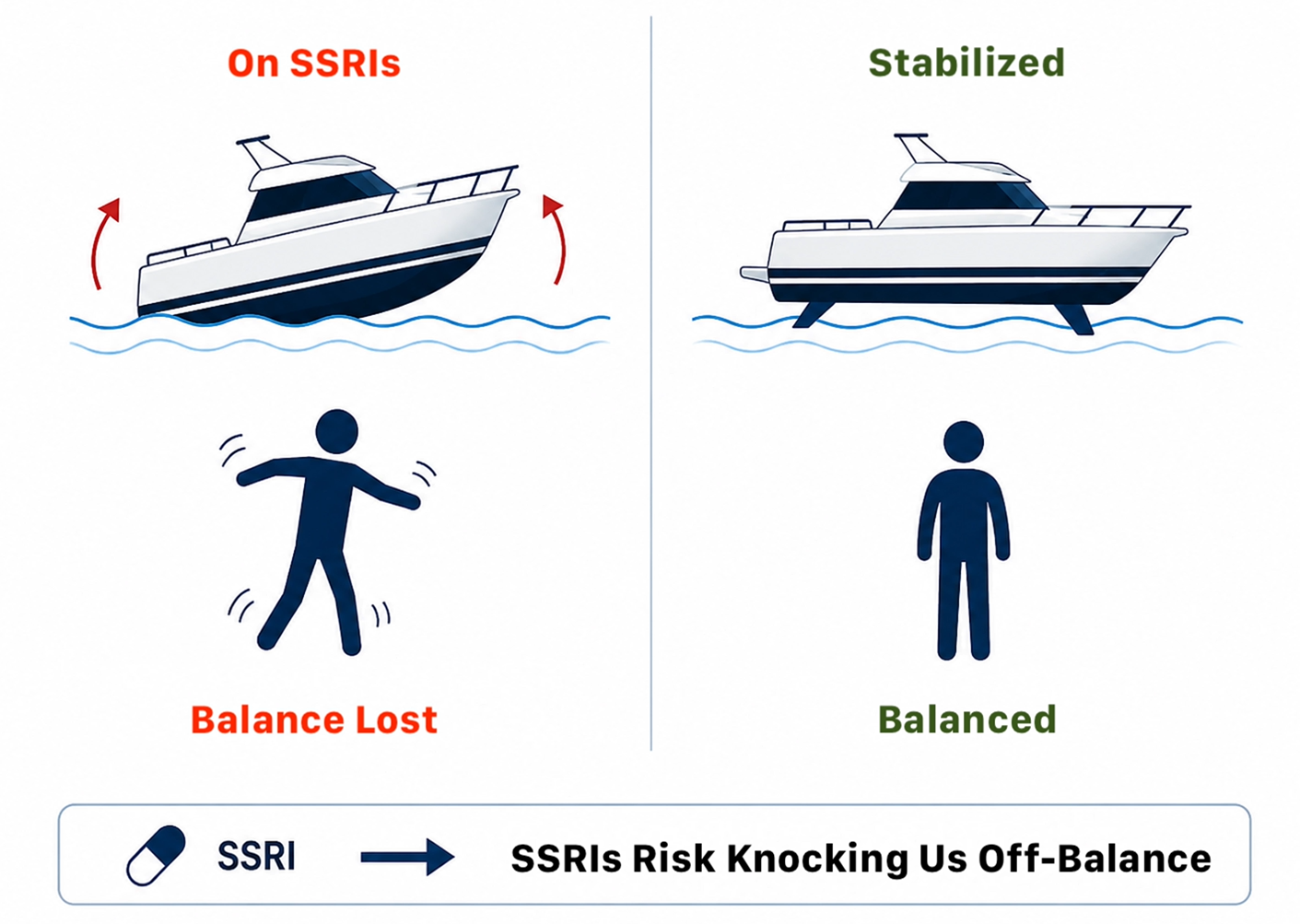
This is also what happens in hypnosis. Doing as we are told and focussing on one thing, ignoring everything else, can put some people who are good at doing as they are told into a trance.
Interviewed after she had killed her children and asked why, many of these women, including Marilyn, respond in a way that sounds like hypnosis. They seem to have been compelled to take a path that opens up even though they had no idea why they were taking it and after the event cannot understand what happened. Unlike Medea, the path for most of these women usually involved an attempt to kill themselves but one of the few things women are less successful at than men is killing themselves.
When both the woman and her children are dead, a jury usually has little problem figuring the balance of her mind must have been disturbed. But if she is left alive and can’t explain what happened, in the absence of a narrative that makes sense, it’s harder to avoid a prosecutor’s demand that they must convict.
Juries need a convincing counter-narrative. This can be reached in some cases depending on the details of the case – one that shows how drugs can have an effect on thoughts we all have from time to time leading one to dominate the way it never could do without the effect of a sensory depriving drug. An SD drug acting on a system more primitive than Estrogen or Testosterone.
Entitlement?
Does Nietzsche help explain the male equivalent to a supposed female template?
Evolution, he figured, had led to civilisation, domestication and the suppression of primordial male impulses. Had led to a crisis in masculinity. Twentieth century versions of Nietzsche have stressed that in order to find a meaning and purpose in life, men, in particular whose lives were cramped and who were suffering from quiet desperation, need to find their inner Wild Man, their Iron John.
There’s little in Nietzsche that says men need to do much more than venture out into Nature to rediscover their true selves. Post-Nietzsche these ideas have accumulated a layer of drastic actions aimed it seems at truly shattering the constraints holding men back. What about wiping out a family?
In recent years, Finland has had a spate of school shootings by young men almost certainly on SSRIs. The common response among Finns is he’s been reading too much Nietzsche. There has also been a spate of school shootings by young men in Thailand. It’s unlikely Thai teens have been reading Nietzsche but social media versions may well be linked.
The most striking case in recent years was James Holmes, a shy university student who had, like many people, vague misathropic ideas. Zoloft acted like Miracle Gro on these ideas. He began fantasizing about doing something, laying out his developing ‘manic delirium’ in a diary. He told his doctor that if she knew the thoughts going through his head, she would lock him up.
She told him he was responsible for any thoughts he had. How responsible are you if you’ve been put on Miracle Gro whose consequences neither you nor your doctor could normally even begin to imagine? What would a jury make of the fact that both your parents, not knowing you had been on Zoloft, and put on similar drugs to manage their shock had reactions like yours? See Prescription for Murder and The Man Who Thought he was a Monster
Holmes killed 12 and injured 72 others at the premiere of Dark Knight Rises at Aurora Colorado. Meeting Holmes in person it was difficult to avoid the sense that like Marilyn Lemak he was mesmerised. His lawyers didn’t choose to play this defense.
Seronauts?
What comes now is where I have problems and need input – especially from readers who’ve been on SSRIs – Seronauts.
There are a growing number of cases where fathers taking SSRIs wipe out families. These killings are not done in acute onset rage attacks that start a short while after beginning treatment, with confusion and amnesia after the event – all consistent with a delirium. No family or friends seem to see this coming.
There are usually clear signs of planning and intent. There is often something semi-Nietzschean in the background and a sense that drastic action is needed. A wife, young children and sometimes other family get killed often savagely – partly because killing to the point of silence often takes more time than expected. The man makes no attempt to kill himself. He may clean up afterwards. He may even be semi-triumphant. There is no amnesia. He gives a coherent account in police interviews when he turns himself in.
We don’t have any accounts from any of these men of SSRI effects that might open a door to understanding what is happening in these cases. In the absence of being able to meet and listen to them for clues – which will have nothing to do with Nietzsche or their social media feed per se – we need more input from men like The Man Who Thought he was a Monster – and his wife.
Opening a door on what might happen aims at saving lives – it does not mean opening a jail door other than to go in and interview them. Why let them simply sit there?
‘Zoloft acted like Miracle Gro on these ideas. He began fantasizing about doing something, laying out his developing ‘manic delirium’
According to news reports the Lindsay Clancy case, whereby she killed her three children and attempted suicide has ‘gripped the nation.’ Lindsay Clancy has filed a lawsuit against multiple mental health providers, accusing them of malpractice that directly led to her children’s murders.
The case recorded on Courts TV. Apparently many Jurors have pulled out because of the ‘horror’ of the case. Currently there are 18 Jurors, 12 female and 6 male of all ages. The Jury will be reduced to 12. A legal person from Courts TV described how Jurors would have many problems with this case depending on their IQ, age, young or older, general capacity to take in information, etc., the approach of prosecutor and defense with bias.
If Doctors and Psychiatrists don’t get a grip on ‘Adverse Affects’ of SSRIs and definitions, then high-profile Court examining is a hiding to nothing. Lindsay Clancy was given Zoloft, Prozac, Seroquel, Amitriptyline, and other antidepressants, antipsychotics benzodiazepines and other drugs, one after the other. It can only take a very few pills to give rise to a huge problem with one SSRI. If no-one points this out to the jury, how can the jury know if she was affected by them.
The Jury needs to swivel their eyes, to a full investigation of the medications, they need an Expert who can tell them if the drug actually had adverse effects on her but as yet in the trial, there doesn’t appear to be one. This risks making the whole trial a circus…
Annie
Don’t take this personally. Annie has taken a lot of material – nearly 900 words from the huge amount of press coverage floating around. But it’s all irrelevant. I’ve chopped two thirds of it away – if people want to read press coverage of the case they can google it.
A legal case like this is not about clinical trials or the so called ‘science’. If a drug is involved it’s about did this drug have an evident can only be produced by a drug effect on this person that is consistent with what then happened. There is no hint from the press coverage that anyone is trying to establish this happening to LC.
D
Like many others, I’ve been following the broad narrative of the Lindsay Clancy case on X. It doesn’t seem like a simple case of the drugs done it. And that’s certainly not the Defense’s position.
It feels more like a case of the adverse effects of the drugs – apart from Ativan that worked briefly for sleep– used in a sort of whack-a-mole way to treat specific symptoms (anxiety, insomnia) made LC feel worse,not better, and certainly exacerbated her deteriorating state of mind. But how much they caused it is hard to unravel.
What makes LC a bit different from us innocents abroad is she is/was a healthcare professional herself – and in a way shares/ed the standard drug-a-symptom mindset of her doctors.
She wrote a note on her phone:
‘I had 3 young kids to take care of and was a touch anxious. So I did what you do…. asked a psychiatrist for some Zoloft.’
https://edition.cnn.com/2026/08/13/us/lindsay-clancy-notes-cellphone-trial
And that was the beginning of a revolving carousel of drugs – all of which made her feel worse not better – as she articulated clearly herself. A few excerpts from quite an enlightening timeline derived from various sources of evidence:
https://www.reddit.com/r/Psychiatry/comments/1vkuh1p/lindsay_clancy_case_full_timeline_and_outline_of/
‘History of developing anxiety symptoms around 4-6 months, symptoms becoming more severe with each child.
10/20/22 L increased Zoloft from 25 mg to 50 mg… feels awful, has insomnia, poor appetite, more depressed, crying all day, mental fog. She allegedly “developed racing thoughts and became paranoid of getting suicidal thoughts, something bad happening, doesn’t want to be alone”. Dr. Tufts discontinued Zoloft and prescribed Ativan and Benadryl for sleep.
11/25/22 – after four days on Prozac, her insomnia worsened and she d/c it. Nurse Paul prescribes 3 different meds: Ambien, Remeron, and Klonopin. The meds did not help with sleep.
11/26/22 – after taking Remeron, she experienced dissociation, “perceiving the world around her as unreal, distorted, and distant. She could not determine what was real. She was forgetful, confused, and unable to drive or be alone’.
Nurse Jollotta “correctly considers Bipolar disorder” and prescribes Seroquel; however, after starting Seroquel, her condition “took a dramatic turn for the worse. She developed suicidal ideation and began experiencing what she described as “intrusive thoughts” – which were actually auditory hallucinations. The voice said “I will not be the same. I want to die”.
What is clear is that Lindsay Clancy’s ‘care’ failed her – and, above all her sweet little children. The first time her final psychiatrist, Dr Jennifer Tufts, saw her in the flesh was – in the courtroom. Her ‘care’ was the opposite of relationship-based medicine.
What I’m finding particularly hideous about this case – in addition to the awful mental image of those little children with the life choked out of them– is the hatred of women that has emerged from some quarters. Matt Walsh has led the assault, in part being acutely toxic for clicks from his 4m followers , in part fulfilling his self-anointed role as ‘theocratic fascist’ (and father of 6):
‘Let’s be really clear about this. If you’re a mother who has ever entertained the idea of murdering your own children, or felt any desire to do so, it’s not because you’re a victim of “postpartum depression.” You aren’t a victim at all. Nobody should feel sorry for you. You’re not worthy of pity. You’re a raging narcissist and you hate your children because they impose on your lifestyle. That’s all. And you know it. It’s not “hormones.” Hormones can’t cause you to develop murderous desires towards your own offspring. Your soul is the problem’.
More alarming than Herr Walsh himself has been the number of men – and some women – who have championed this revolting sentiment – expressing it far more crudely. It’s disturbing to have to share a planet with these people.
It’s important to get this right
‘The first time her final psychiatrist, Dr Jennifer Tufts
Tufts was her first psychiatrist who did telehealth 14 times
This was followed by a further psychiatrist who saw her 3 times
This was followed by 3 further doctors/psychiatrists
This was followed by a voluntary stay at a medical institution for 5 days
This was followed by 2 calls to a Suicide Hotline who sent her away
This was followed by an attempt to enrol in another programme to stay in a further medical institution. She was sent away as they told her she was over medicated and did not fit their programme
None of her doctors/psychiatrists shared any information or prescribing with each other
Her defense attorney interviewed an Expert named Paul Zeizel yesterday who was able to discuss Zoloft and SSRIs in some detail. This is available on you tube.
I prefer to watch/listen to some of the actual trial events, rather than listen to the ghouls who seem to be out in force, as even the media are producing articles on said ghouls…
Two points. There was a smartalec line about Jennifer Tufts seeing her on TV. Seeing her on TV is not a problem. You can still look and listen and gather evidence – details of what exactly any of these meds did to LC. All I’ve heard is she complained about feeling worse. Well if you’re a juror in a murder trial you said – she would say that wouldn’t she. Thats not going to pull the wool over my eyes.
Don’t get me wrong. I’m not saying this is L’s fault. There is no evidence any of the doctors pursued this and tried to work out exactly what these drugs were doing to her that they might not do to me or any doctor asking the questions.
No comments from anyone have given me any indication that anyone has picked up something distinctive to LC – a fact about her rather than an opinion of some sort about the drugs.
Did Paul Zeizel who talked about Zoloft and SSRIs give us any facts about LC. Is he talking about these drugs without having ever talked to her?
D
All credit to Dr. Zeizel who took in all the emotion in this case and who gained access to all Lindsay’s medical records from her doctors, psychiatrists and the various hospitalisations she had.
He met Lindsay over 60 times to talk to her personally after the murders and attempted suicide took place.
She was shackled in her bed with handcuffs and two police officers outside her room. She had no access to a phone to talk to her husband, Patrick. Dr. Zeizel let her use his phone, as he said, ‘out of human compassion.’
It is important to hear what she said to Patrick in front of Dr. Zeizel. She told him that a male voice had told her to kill her three children and to kill herself.
The full testimony is available on you tube.
Annie
Thanks for this – you’ve caught my interest. I went and listened. There is still nothing much if anything on the meds. They seem to be majoring on post-partum psychosis
D
I know this isn’t a Lindsay Clancy thread but I could not help noticing her psychiatrist authoritatively stating:
“SSRIs increase the serotonin [in the brain]” and “many individuals with depression have low levels of serotonin”
Are entranced, spellbound, board-certified psychiatrists still taught this in USA?
https://www.youtube.com/watch?v=F5OUJsoYOYE&t=630s
Rosie Meysenberg created SSRI stories because of the obvious personality changes these drugs produced – See The Story of SSRI Stories (We hope to resurrect this soon).
SSRI stories was always highlighted on the blogs and it was an intrinsically good place to go and research. It was missed. This is how it appeared.
https://web.archive.org/web/20210119085027/https://ssristories.org/
Click here to view these and other RxISK.org research papers.
This archive version is in full working order.
“In recent years, Finland has had a spate of school shootings by young men almost certainly on SSRIs”.
I imagine all of us who have learned so much from RxISK, DH Blog, and our own tragedies caused by SSRIs/SNRIs/ADs – —>
(so often inappropriately prescribed, without any attempt whatsoever to treat our loved ones, or ourselves with fair, full and informed consent) —
— > Immediately gasped to ourselves and our families: “Oh no not Finland now -SSRIs again”?
These two back to back, new D.H. posts were “Spellbinding” and made compelling reading and re-reading.
Prescribers seem to be largely ignorant of, and/or in denial of the life-terminating or life-destroying adverse outcomes. There seems to be almost daily, media supported propaganda promoting the perceived necessity for psychiatry, and its dangerous drugs.
The suggestion of low dose SSRI introduction, a few days trial, and patient, plus family awareness of potential ADRs would have allowed our damaged and destroyed loved one to continue her joyous and fulfilling life which was just unfolding before SSRI exposure and injury for no valid medical reason.
Without the support and care afforded by those who founded RxISK, we believe absolutely that unnecessary psychiatry and its enforced drugging, incarceration and cruel, sadistic ‘nursing ‘ care would have killed her by now.
I try to increase awareness of Antidepressant induced AKATHISIA – its misdiagnosis as ‘Serious Mental Illness’.
and the risk of violence against self and/or others, in response to relevant, published medical articles.
These attempts to are sometimes apparently resented and rejected by those prescribers most in need of understanding. Why won’t they hear us? Why can’t they understand the suffering?
Thank you for your commitment and wonderful writing which maintains our hope that patient safety might eventually be afforded priority over dogma and unshakeable, inappropriate belief in antidepressant efficacy and safety.
I was thinking back to what happened when I restarted Seroxat/Paroxetine after 6/7 weeks off.
After violent attacks on myself and before I went to a general hospital after coming out of a mental hospital which I insisted the doctor sent me to because of unbearable symptoms.
Around 6.30 in the morning I stood in our bedroom with blooded wrists. My partner woke up and looked at me. “Jesus Christ! For fuck’s sake”.
After the shock he ran me a bath and went off to make coffee. Because of my absence from home our labrador was in kennels approx. 8 miles away and this was the morning to pick him up. I wrapped bandages around my wrists and drove off to pick him up leaving my partner to look after our young daughter. The woman who ran the kennels was a friend, we bought our dog from her and I used to help out in the kennels when she was very busy. One look at me and we sat down. Blood was leaking from the bandages. We agreed that my dog would stay at the kennels and I drove home.
This put me in mind that after suicidal acts and a Seroxat induced ‘psychotic break’ normal functioning happens almost as if nothing had happened.
I wonder what a jury would make of that?
I understand how the mind can become narrowly fixed on one vivid image or idea in the sensory deprivation tank of SSRI effects. A bit like an old-fashioned movie projector getting stuck. Especially at what seem like very high doses – I think I read Marilyn Lemak was on 200mg Zoloft. Lindsay Clancy started to lose her mind when her dose of 25mg was doubled:
‘0/20/22 – L tells Dr. Tufts she increased from 25 mg to 50 mg and she feels awful, has insomnia, poor appetite, is more depressed, crying all day, mental fog. She was *“terrified to start something new”. She allegedly “developed racing thoughts and became paranoid of getting suicidal thoughts, something bad happening, doesn’t want to be alone.’
Deidre Morley, whom you brought to my attention, like Lindsay Clancy, was prescribed about 5 different antidepressants and seemed to bump up the dosage herself. It’s hard to ignore the fact all of these women were nurses, perhaps underpinning their faith in drug interventions.
Whilst I get the idea of the perceptual boat or movie projector being stuck for lack of ongoing stabilising sensory input, there’s also the question of the what drives the violent or fearful content? Pretty obviously- amateur sleuth at work – I guess part of it is the surfacing of the terrors that lurk latent in all our minds. Maybe unleashed by SSRI induced disinhibition? I also wondered about the contribution of disrupted REM sleep and the nightmares that seems to bring, another SSRI special? It’s significant that insomnia is present in many of these awful infanticide cases – usually put down to a post partum state , but how much is the drugs? Equally, is an intoxicated or poisoned system reflected in the content – in the way that fever and/or food poisoning can give us nightmares? There’s a lot of malarkey written about serotonin and amygdalas – that makes little sense to me.
Kevin Reddington has wheeled out some pretty convincing witnesses in the Lindsay Clancy case. Father Bob was a holy cracker, sort of invoking the integrity of God against beliefs that LC might be lying about her mental state. The other one, whose work you’ll know well, new to me, was Phillip Resnick, forensic psychiatrist and expert in filicide, who developed a motivational framework for understanding the different drivers of filicide, Essentially five – 1.altruistic, 2.psychotic, 3.unwanted child, 4.child maltreatment and 5.spouse revenge. He fleshes out the categories with horrifying examples.
1. Filicide to relieve or prevent suffering
Andrea Yates’s motive for her filicides was to ensure that her children would not go to hell. Thus, her filicides would fit this category by preventing an eternity of suffering.
2.Acutely psychotic” filicide
This designation applies to psychotic parents who kill with no comprehensible motive. It includes patients who kill under the influence of command hallucinations, epilepsy, or delirium. Hopwood (1927) reported one case of an epileptic mother who placed her baby on the fire and the kettle in her cradle. In a recent case, an epileptic woman in Sacramento placed her infant in a microwave oven during a period of postictal confusion (Smith, 2015).’
https://pmc.ncbi.nlm.nih.gov/articles/PMC5282617/
He categorised Lindsay Clancy as a 1 + 2. He asserts that the majority of women diagnosed with post partum psychosis have a bipolar or schizoaffective disorder – which seems bonkers to me. I couldn’t find so much as a mention of the adverse effects of mind and body altering drugs, which seems wilfully obtuse.
In Resnick world, fathers who kill their children are most likely to be categorised as Types 4 or 5, the child maltreatment and spouse revenge segments. One reason why there is so little public information about what’s going on with these guys is probably that most ‘family annihilation’ cases, as they’re known, involving male perps, is that they kill themselves, so there are no legal proceedings or trials, no public toxicology data etc.
There are some chilling US stats delivered by my know-it-all mate, Grok:
‘… Gun Violence Archive and media reports indicated at least 9 of the ~15 mass murders through mid-August met family annihilation criteria (killing multiple close family members, often including spouse/partner and children), nearly all by men. Broader historical patterns show ROUGHLY ONE SUCH INCIDENT EVERY FEW DAYS ON AVERAGE IN THE U.S., WITH ~94-95% OF PERPETRATORS MALE AND FIREARMS USED IN THE LARGE MAJORITY.’
Contrary to my assumption that these awful crimes are most likely driven by long term poverty and despair, the evidence suggests that these men are more likely to have been materially successful, although a sudden fall from grace – redundancy, business failure can be ‘triggers’ to a supposed state of shame, humiliation, when they feel their family might be better off dead too. Depression is often part of the analysis – no mention of the medications that are likely to be the corollary.
https://www.latimes.com/archives/la-xpm-1995-09-20-ls-47831-story.html
Mack the knife…
Two elderly forensic psychiatrists supported LC to the extent it was postpartum psychosis with auditory hallucinations.
Kevin Reddington ,Defense, himself 75, and a biker, would have been pleased with that.
But then, the Commonwealth, Prosecutor, brought in a rebuttal, a younger guy, everyday, general psychiatrist. This brought a huge spanner in the works. Kevin R, obviously thought he was a player, and to prove his point, went on at length to discredit him by going through his CV, at length, on and on and on, trying to get a point across that he had no experience at all in postpartum psychosis. It got pretty heated and Kevin R, pushed the DSM 5 at him, just a paragraph in it about postpartum psychosis.
Now, this Professor of psychiatry at a university, used the DSM as his bible. He used it as a classification for his diagnosis and prescribing. He talked to LC, and his opinion was he agreed with the prosecutor that it wasn’t postpartum psychosis and it wasn’t bipolar. His diagnosis of LC was based on depression. His tack was based on depression as in DSM 5. He supported Tusk and all the other doctors in their prescribing and thought they prescribed accurately based on depression.
He didn’t buy postpartum. He bought in to depression.
He didn’t have a problem with Zoloft and the dose being doubled, he didn’t have a problem with the several other antidepressants prescribed after Zoloft; Fluoxetine, Mirtazapine, Amitriptyline, prescribed by Tufts and Paul, September to January.
Kevin R was extremely rattled with this psychiatrist but not for what I have said about the antidepressants, but for the fact that the psychiatrist would not entertain postpartum psychosis. It would have gone on for much longer if not for the judge pulling time on proceedings.
What with Postpartum psychosis and what with Antidepressants which can lead to toxic drug states and psychotic episodes and hearing voices, will the jury favour biker Redd, or the two Commonwealth girls determined to lock her up in a prison cell, along with the smooth, rather self-centred, non-empathetic, psychiatrist, Mack.
Day 18 – Dr. Mack
“He didn’t, and his family didn’t and his partner didn’t figure the drug was to blame and everything would be fine if he just stopped.”
This, taken from the present post, refers to Shane when first prescribed Seroxat. It is true that none of us, in that first month, put the blame entirely on the drug. We were all horrified at the changes that we were witnessing but couldn’t find anyone that was willing to give any explanation beyond the “it takes a few weeks for it to start working” mantra.
Shane was put on 30mg of Seroxat from day one. Had we – or he – felt that the fault was with the prescription and stopped it after a few days, would that, from the high dose, have been safe? I can just hear you say that it couldn’t have been much worse than what DID happen!
It took three months of repeated instances of unbelievable changes of behaviour before we got the answer – that Shane and Seroxat did not suit each other! During those three months I had, at every opportunity, enquired about the dose and nature of the problems – had such problems been seen previously; why had the dose not been changed; wasn’t more support for him (and us) something that could/ should be provided – but nothing changed. Once the Seroxat was removed, I remember a discussion with the psychiatrist, whereby he admitted that the Seroxat was wrong for Shane, so I asked ( or possibly screamed!) “then why on earth didn’t you stop the prescriptions?” only to be told “Well, I wasn’t the one who put him on it in the first place”. This psychiatrist had seen Shane a number of times during the three months that the Seroxat was prescribed.
We were blind to what was going on due to never having experienced anything of this nature before. Surely the “professionals” should have been able to work out what was going on…… or was it just easier to blame each other and leave the patient to face the consequences of their silence? Without our continued supervision, the events of the following two months could have had even more serious consequences, possibly with fatalities.
Playing games with us by psychiatrists is not remotely funny. I asked my psychiatrist outright “what did you think when you heard what happened happened to me?” He said “I was surprised.” He looked momentarily confused. Hardly surprising when my doctor did not tell him anything as to why I was admitted to his hospital – nothing, zilch, zero. Nothing about Seroxat cold turkey, nothing about me being in the surgery screaming in agony almost daily for several weeks, nothing about giving me benzos and beta blockers, nothing about how she had disregarded his letter with advice about antidepressants.
You couldn’t make it up. Shoddy, neglectful, especially when we are dealing with near fatality.
With antidepressant nobody knows what they are talking about. All the thousands of research papers, all the skulduggery by pharma, all the breathtaking amounts of fines, and where are we?
Still arguing the toss.
Court cases, some won, some lost.
They seem to have a pretty weird idea of death. Casual.
When my heart was crashing out of my chest, I wanted to see a heart doctor. Nothing happened for weeks and I was desperate, I thought they would be on it. The doctor called me from Heathrow Airport to say sorry he had forgot, but he had done it now. The heart doctor was brief. I am not going to check out your heart or give you anything because I see you swallowed a whole packet of beta-blockers. You couldn’t make it up.
Thank you for this, wrote a review and shared it over here:
https://fndnope.org/posts?postId=140
FND Nope’s review of this blog (linked in the final comment above) – set the cat amongst the FND budgies on X.
‘Psychiatrist and psychopharmacologist David Healy has upset parts of the FND community with his August 2026 article Entranced, Spellbound, Mesmerized. He calls Functional Neurological Disorder medicine’s “new toy”, writes “FND (hysterical)”, and says that an FND diagnosis in the medical record can become a “one-way ticket to never being taken seriously again’
It is provocative. It is supposed to be provocative. But getting angry about the language is considerably easier than answering the patient-safety problem underneath it.’
https://fndnope.org/posts?postId=140
For anyone who doesn’t know of him, Christoff Truter aka FND Nope is a highly intelligent, critical thinker. His wife is ill, her health deteriorating. An early, utterly confident FND diagnosis proved to be a meaningless distraction in an urgent search for answers.
One central criticism of this blog from hardcore FND believers is that it is ‘ignoring patients with FND who have never taken the drugs that you claim may be behind their symptoms. Or children with FND.’
Hmmm, I thought, this seems a bit unsatisfactorily vague. What can we find out about how many of those diagnosed with FND came ready medicated and which drugs were they on?
A couple of telling studies, (there are more along the same lines), both with disclaimers – ‘This does not mean the non-medicated group had never taken any medication previously’.
1. Paediatric FND
Specialized inpatient/rehab program study 158 children/adolescents, ages ~8.5–17.6):
On admission, 63% (n=95) already on rx medications (most commonly antidepressants for anxiety/depression, antipsychotics for arousal/anxiety, melatonin for sleep, and others for arousal, gut symptoms, or pain). This implies ~37% were not currently on medications at that point.
During the program, most had pharmacotherapy adjustments, and 88.6% were discharged on medications.
https://www.researchgate.net/publication/393789297_The_adjunct_role_of_pharmacotherapy_in_multimodal_treatment_of_paediatric_functional_neurological_disorder
2. Adult motor FND (UK MH service case-control study of 322 patients): 76.7% had been rx medication Among those on meds, polypharmacy was common (mean ~4.8 agents), including antidepressants, anti-epileptics, and analgesics. Thus ~23% were not currently prescribed medication in that cohort,
And the conclusion – an example of confirmation bias so perfect it takes your breath away.
mFND patients are prescribed an extensive range of medications for psychiatric and somatic symptoms, most commonly anti-depressants, anti-epileptics and analgesics. The diversity in medications may be partially explained by higher rates of physical co- morbidities but may also reflect ‘somatisation’ or excessive symptom reporting combined with a lack of therapeutic options for clinicians managing patients with complex functional and ‘organic’ conditions and chronic pain. NON-ESSENTIAL MEDICATION PRESCRIBING MAY REINFORCE SOMATIC ILLNESS BELIEFS AND CAUSE IATROGENIC HARM, PARTICULARLY HIGH RATES OF OPIOID PAIN MEDICATION..
https://jnnp.bmj.com/content/90/Suppl_2/A17.1
Thanks for picking this up. It’s a far far more serious problem than most people can imagine. The FND community aren’t noted for opening up discussions – engaging in efforts to work out how to ensure drug induced toxicities don’t get dragged into the FND dragnet.
D