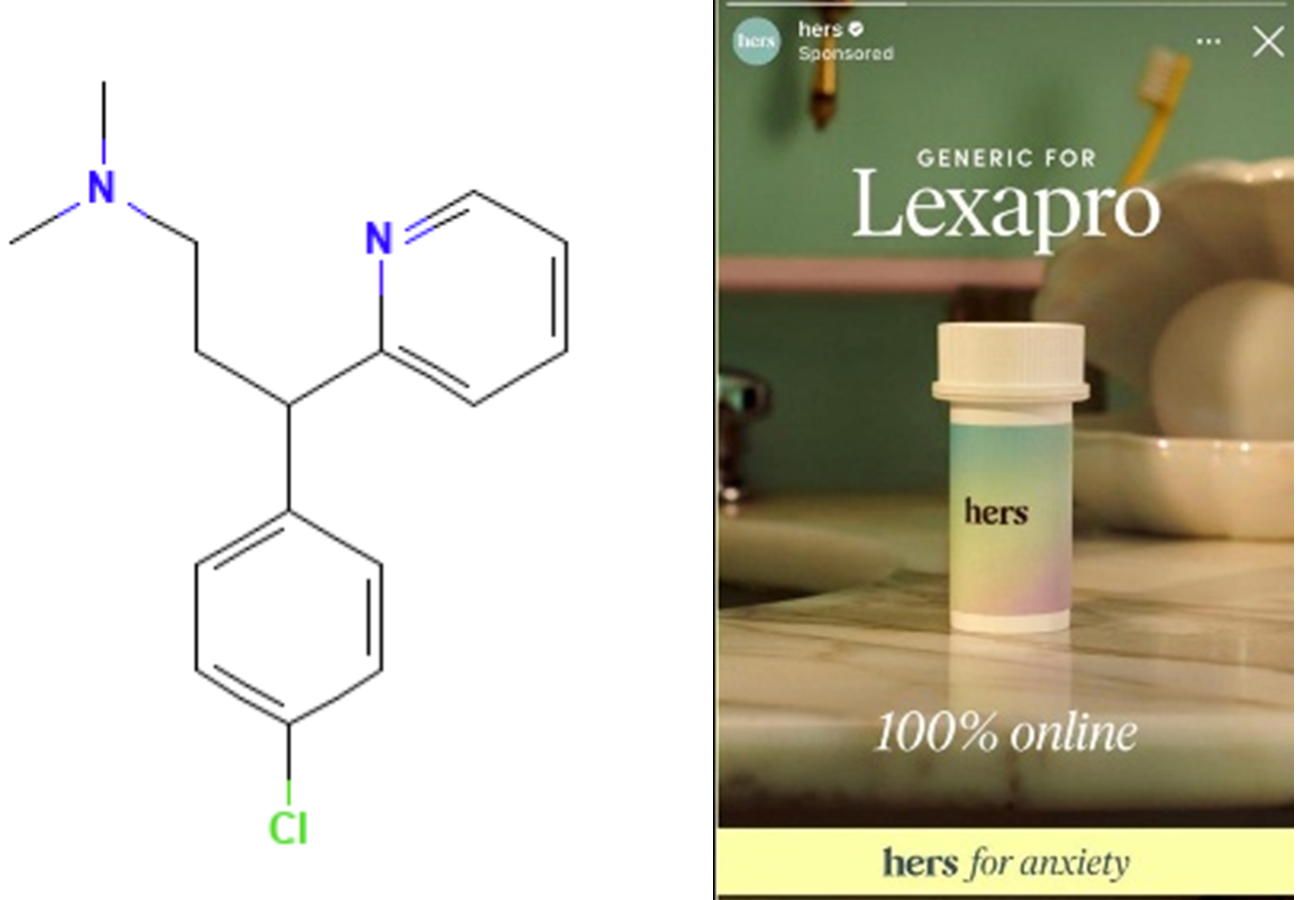
Two weeks ago, RxISK ran Authenticity Inc., a post by Johanna Ryan, which tackled a growing story – the exponentially escalating use of SSRIs among Tik-Toxing and Instagramming Gen Zs, more women than men. A generation for whom these drugs were never approved and for whom SSRIs come with Black Box warnings for suicide.
In this post Tik-Tox meets AI following on from AI’s encounters with RSV vaccines – The Miracles for Artificial Intelligence, with Trans issues – Artificial I, and with ECT – AI Tsunami.
Building from a Wall Street Journal article about dependence on and difficulties withdrawing from SSRIs, Jo laid out the role of influencers on social media channels, being paid lots of money by online providers to promote prescription-only meds like SSRIs, ADHD meds, Propecia for hair restoration, Wegovy or Mounjaro for weight loss, or erectile enhancers. The online providers are companies like Hims and Hers, who provide nurse or other prescribers who approve the provision of whatever with little oversight.
OTC and Online
At the end of The Antidepressant Era 30 years ago, I offered a thought experiment. What if these drugs were over the counter (OTC) rather than prescription only. This wasn’t a policy proposal. I wanted to draw attention to the fact that since the 1962 FDA regulations, for a doctor to give you Prozac, they need to give you Depression. They need to disable you.
If you let doctors do this, you have to be sure they are going to bring good out of this injury. But in a nice doctor’s office, or even a nasty one who you might need to keep on the right side of, who is going to think an injury like this could be routinely happening or could have serious consequences. What politicians are going to spot that this is a recipe for disability rates increasing exponentially and perhaps bankrupting states – see The Great Silence. And Welfare State Conspiracy of Silence. And Embracing Healthcare’s Opportunities.
As I made clear, the pre SSRI, tricyclic antidepressants (TCAs) embodied several different therapeutic principles and I could give you one like trimipramine (or mirtazapine now), which doesn’t block any reuptake but is sleep and appetite enhancing – almost like an old-style tonic. Without disabling you, we could both agree a short spell on a tonic you could pick up OTC might do you good. We might have agreed it’s something we all need from time to time.
The same could be done for keeping our arteries and bones young and lots of the other risk factors, we now get given diagnostic labels and disabilities for. In fact it could apply to most of our medicines – the ones from which pharma now make 90% of their money.
Another benefit of this thought experiment was that it would liberate professionals who didn’t make their living from these drugs, who would have no incentive to praise them to the Heavens or deny the problems they can cause, to give you decent advice – you don’t have to believe all the stuff you see in the adverts.
Switching to OTC bears thinking about as a policy proposal now. The molecule on the left in the image above is a potent SSRI, the progenitor of SSRIs, and capable of causing all the problems SSRIs cause. But if Woody Witczak, whose suicide was caused by Zoloft, had taken chlorpheniramine and not Zoloft he would be alive today. Why? Because chlorpheniramine is available over the counter, and if it didn’t suit Woody, uninhibited by a good doctor, he’d have stopped it – See Health, Care and Science for Woody’s story and also the forthcoming In Praise of SSRIs.
Another angle on this that doctors need to pay heed to is that if the drugs are as good as we are told and free of problems as we are told, then nurses and pharmacists are going to be cheaper prescribers. This is in fact happening quite rapidly now.
Now I wasn’t completely dumb 30 years ago and The Antidepressant Era says that if these drugs were OTC pharmaceutical companies would find a way to ensure that all of us – not just doctors – don’t have a thought in our heads not put there by them. The use of Tylenol in Pregnancy, the drug most commonly taken in pregnancy is a great example.
We are now getting a fascinating insight on how companies like Hims and Hers are using a key trick pharma developed. The Creation of Psychopharmacology 25 years ago spelt out the trick. They are using instruments, like rating scales, blood tests or bone scanners, that create figures which their drugs can put right for us.
Treating our numbers is a powerful conversion tool. Checking the figures for our weight began in France in the 1860s. A decade later a new disorder was born – anorexia nervosa. Fasting which had been a way to holiness, rapidly became a health and beauty aid with targets as stepping stones.
Hims and Hers and related companies have gone out of their way to create Food Noise scales – See the Links Jo added to Authenticity Inc – to sell Wegovy and Mounjaro. On these drugs, the scales will show that the distracting noise about food has been muted or eliminated.
For prescription only drugs, companies ensure doctors don’t have a thought in their head not put there by them. The goal for OTC meds is to ensure this is true for all of us. Partnerships with medical and patient groups is an important part of this but the key element is focusing on figures and making the transactions about getting our figures right rather than us right.
Big Pharma, as we call it now, had just been brought into being in the US around 1960 on the back of drugs that met real needs and kept us alive. The name suggests they are still making drugs to meet our needs and save lives. But as Goldman Sachs have told us, making drugs that save lives is a bad business model. The price of life-saving drugs pushed down. The money lies in meeting our wants rather than our needs and this opened the door to Big Pharma shape-shifting into Big Propaganda.
The goal of the best propaganda is to be invisible. Telling us to Follow the Science and getting doctors to practice Evidence (company trials) Based Medicine is as close to invisible as any propaganda has ever got. AI, Total Propaganda has made the message even more seamless.
Chicago and Grok
Jo is from Chicago. Coincidentally, a Chicago group have just published an article in JAMA on the role of social media influencers in this new market – High Engagement Social Media Posts Related to Prescription Drugs. This concludes that:
Drug promotion content is frequently posted by individual creators, lacks essential risk information, and bears the hallmarks of undisclosed marketing. These findings suggest that posts circumvented established advertising principles and potentially eroded the fair balance crucial for informed patient decision making, consistent with prior literature on traditional DTCA’s impact on prescribing.
While the federal government has proposed expanding oversight to include influencer partnerships and sponsored content, effective oversight will be challenging because promotion is driven by thousands of individual creators rather than a few dozen companies.
Two other members of the RxISK Team, Harriet Volk and Yoko Motohama, fed this JAMA article into Grok pitching their ask slightly differently. A Full Grok Response is included here, with excerpts below.
Grok, as might be expected if you know anything about its background, replied:
While the study provides some empirical data on content patterns, it’s biased toward over-regulation. Far from justifying calls for expanded federal oversight, the findings underscore the value of social media as a democratized platform for authentic patient experiences that empower consumers—benefits that outweigh the authors’ exaggerated concerns about “circumvention” of rules.
The discussion pivots to sweeping policy recommendations, such as expanding oversight for “thousands of individual creators.” This is a classic case of extrapolating from a skewed sample to indict an entire ecosystem.
Funded by Arnold Ventures (a philanthropy known for progressive advocacy on health policy), the study aligns with the cited HHS fact sheet proposing DTCA reforms. This isn’t neutral science; it’s advocacy disguised as empiricism, framing user-driven content as a regulatory “complexity” to solve via “expanding oversight to include influencer partnerships.” Regulating diffuse, authentic voices would require dystopian surveillance (e.g., AI-flagged “promotional language”), chilling free speech and disproportionately burdening non-commercial creators like patients sharing coping strategies for ADHD or autoimmune conditions.
Algorithmic amplification? That’s not a flaw—it’s how platforms surface relevant content to those seeking it, countering the information silos of broadcast ads. The low pharma presence (4.5%) further debunks conspiracy: if anything, social media dilutes corporate narratives with diverse, unfiltered perspectives.
Kresovich et al.’s study, while competently executed in data collection, falters under scrutiny as a biased call-to-arms for overregulation. Its selective metrics and presumptive labeling of organic content as “promotion” exaggerate harms while downplaying social media’s role as an empowering tool for patient voices…. Instead, trust users’ agency, promote digital literacy, and protect First Amendment expression. If anything, the data affirm: let patients speak freely, without Big Brother’s heavy hand.
His and Her Suicides
In a recent lawsuit, Colleen and John Tyler allege that less than an hour after Hims targeted their son, Luke, through an Instagram ad, a Texas-based Hims “provider” prescribed him 90 days’ worth of an antidepressant known to increase the risk of suicide in adolescents without any consultation, despite Luke’s disclosed history of undiagnosed depression and “bad self-harm habits.”
Thirty days later, the same Hims “provider” doubled Luke’s dosage and Hims sent him another 90 pills, still without speaking to Luke. During this time, Luke was being hazed by the WSU chapter of Theta Chi Fraternity, Inc. (Theta Chi), the fraternity he was pledging. The night before “Hell Week” was supposed to begin for his Theta Chi pledge class, Luke died by suicide using the Hims-prescribed medication.

The best account of events is in the Tyler Hometown newspaper – Family Files Lawsuit Against Telehealth Company.
Looking for a healthier way than suicide attempts to manage his distress, Luke clicked on Hims and Hers. Pills were sent to him without a conversation. The pills didn’t suit Luke. He took very few of them, but despite mentioning this when he again contacted Hims and Hers, more of the same pills were sent again without a conversation.
When he was ‘hazed’ at College, he overdosed and ended up with blood levels 20 times the toxic dose of bupropion.
Suicide rates in this age group have risen dramatically in both males and females in the last decade.
Jonathan Haidt and Danny Blanchflower put these increased suicide rates down to bullying on social media. See Damsels in Distress. Bullying can be a problem and social media did play a role in this case but not in the way Jonathan and Danny figure.
Algorithmic amplification? That’s not a flaw—it’s how platforms surface relevant content to those seeking it, countering the information silos of broadcast ads. The low pharma presence (4.5%) further debunks conspiracy: if anything, social media dilutes corporate narratives with diverse, unfiltered perspectives.
…. Instead, trust users’ agency, promote digital literacy, and protect First Amendment expression. If anything, the data affirm: let patients speak freely, without Big Brother’s heavy hand.
Big Brother’s heavy hand?
“Social media posts are bite-sized, not FDA-mandated TV ads requiring exhaustive risk recitals.”
Exhaustive risk recitals?
Hims – Official Site – Stop the awkward doctor visits
Hims and Hers seems like OTC; over the internet, OTI
His and Her Suicides
“This is the first offering with Hims & Hers I’m encouraging all of my family and friends to sign up for.
The power of knowledge and early action is unmatched, and for the people we love there is no greater gift.”
https://x.com/AndrewDudum/status/1989073033768898914
‘after Hims targeted their son, Luke,
The Tylers claim Luke’s death was a foreseeable consequence of Hims’ dangerous expansion into mental healthcare, via telehealth, shortly before their 2021 IPO that made hundreds of millions of dollars for the company’s founders. They also allege that Hims built its telehealth business around tightly controlled Affiliated Medical Groups (AMGs). Those AMGs have been run by a handful of unqualified medical professionals, including one who recently pled guilty to a nearly $2 million federal healthcare fraud via telemedicine; another who was sanctioned by the Florida Department of Health for prescribing an excessive amount of Benadryl over telemedicine; and a third who had her medical license suspended in at least twenty states for, according to one medical board, prescribing medications without establishing “a valid physician/patient relationship, utilizing a questionnaire in lieu of physical examination” and “dishonorable or unethical conduct likely to deceive, defraud, or harm the public.”
https://sgb-law.com/news/family-alleges-hims-and-hers-health-incs-rush-into-mental-healthcare-violated-washington-law-and-resulted-in-sons-death
Alan Cassels reposted
Jim Gottstein@jimgottstein
@PGtzsche1has written an excellent piece about psychiatry killing people with legal impunity.
https://brownstone.org/articles/why-lawsuits-about-psychiatric-malpractice-are-difficult-to-win/
‘When people under psychiatric care commit suicide or homicide, or are killed or seriously harmed, because of medical malpractice, it is extremely rare that it has any consequences for the doctors.
Psychiatry seems to be the only area in society where the law is being systematically violated all over the world. Even Ombudsman1 and Supreme Court decisions2 are being ignored.’
Even when there are no consequences for the doctors, Hims and Hers creeps in, legitimately, it seems. Where do things go from here.
Treating our numbers is marketing 101 – standard stuff for companies selling almost anything. But, as you say, what a key trick it’s turned out to be in drug sales. Effectively turning companies’ own effectiveness criteria into the way a drug is evaluated as needed or working in clinical practice. Ofc the whole human being in the context of their existence is missing – more fractured alienation from self.
It’s especially crafty because it achieves, as you say, ‘the goal of the best propaganda – to be invisible’. What appears to be more ‘objective and scientific’ than an individual measurement of your cholesterol level, blood pressure, responses to a ‘validated’ bipolar questionnaire etc. Seemingly very few say, hang on a minute, what’s the belief system behind all this? When out dog walking, I’ve helped haul quite a few seniors to their feet whose antihypertensives have floored them, despite their doctors being ‘pleased with their numbers’.
Consumers – patients – who are also doctors – generally find self-help, self-diagnostic tools irresistible – body type vis-à-vis exercises and diet, occupational best fit , ideal partner profile baloney (though I gather ‘self-partnered’ is the new mode). So there’s a real world drive and a habit underpinning ‘treating our numbers’.
I had a look at Ro and the ‘Food Noise Scales’ Jo posted. Well, at least I’ve applied for the questionnaire. It’s a sure fire winner. One sure fact about most people who are concerned about their weight or on any sort of a diet is that they are often, obviously, preoccupied with food. Which is exactly why most restrictive diets based on actual food are doomed to fail. I guess that’s what Wegovy and Mounjaro are – restrictive diets without so much as a by your leave. Worth the risks for people with weight exacerbated deadly comorbidities. But, as usual, another blockbuster disaster zone – the lawsuits have started. https://www.motleyrice.com/diabetes-lawsuits/wegovy
Luke’s death by Hims’ care-less numbers is utterly tragic. And the fact that US colleges still allow Lord of the Flies style rituals – unspeakable.