This post links to Functional, Fashionable or Toxic and to Ariadne’s Thread and Post-Mefloquine Toxicity as well as to Marion Brown’s The Rise and Rise of Functional Neurological Disorder on Rxisk.
To make sense of FND and NFD, it is worth listening to, reading and considering these Jury Instructions Judge Bill Sullivan gave the Jury at Lindsay Clancy’s Homicide Trial:
Because an expert witness has specialist training in their field does not put that expert witness on a higher level than any other witness. You are to treat an expert witness just as you would treat any other witness. You may believe all of the experts testimony, none of it, or anything in between those two extremes. There is no requirement for you to believe an expert merely because they are an expert
As with any other witness, it’s completely up to you to decide whether you accept the testimony of an expert witness, including the opinions that the witness gave. It’s also entirely up to you to decide whether you accept the facts relied on by the expert, and decide what conclusions, if any, you draw from the expert’s testimony. You must, as has been explained, keep firmly in mind that you alone decide what the facts are.
If you conclude that an expert’s opinion is not based on the facts as you find those facts to be, then you may reject the testimony and the opinion of the expert in whole or in part.
Scientific experiments and clinical encounters resemble a homicide trial. A jury is asked to come to a consensus, which we call a conclusion (science) diagnosis (medicine), or verdict. This consensus establishes a fact. It is a fact that we agreed on a verdict of guilt, diagnosis of heart attack, or conclusion that light is multicolored. In science, law and medicine, any consensus is open to revision if new observables emerge. These test the prior fact and may establish a new one. New observables and a new consensus count, opinions per se don’t.
Bill Sullivan is telling the jury in the Clancy case they must deal with facts. He is reading standard lines but does he hint experts often don’t stick to the facts? As patients or jurors, we may experience a mélange of experts offering views like bipolar disorder, post-partum psychosis, depression or functional neurological disorder (FND). These are opinions not facts. A medical expert pointing to scans or blood test results comes closer to dealing with a fact – something we can see and agree on what we see. But there may be more than one opinion about what this means, and further testing may be needed to establish a fact.
The Facts
- That night I went from 25 to 50 mgs Zoloft.
- I didn’t sleep for 48 hours and I wasn’t tired.
- Paranoid of getting suicidal thoughts, of something bad happening.
- I really don’t like the way I feel on Remeron,
- I know that I can’t stick with taking it…
- I started having intrusive thoughts I never had before.
- Concerningly numb right now, like I have no emotion whatsoever.
- I feel like I’m going to die, and I don’t care.
- Horrible intrusive thoughts.
- Never felt anything like this before.
- Feeling numb, not myself, worse not better,
- crying all day, mental fog,
- Depression worse. Anxiety worse.
Lindsay Clancy’s texts about drug effects are among the few things that can be seen and agreed upon in her case. There are likely more from her and her family. They are observable and consistent with reports from thousands of others as to what happened to them on drugs like hers. See Horrendous Investigation.
Unsupported by facts, opinions differed in her case, from bipolar disorder to post-partum psychosis. (A neurologist would likely add FND to the mix). In contrast, it is a fact she began noting these effects after she started various drugs.
Her reports have by and large not ended up in her medical records which are full of opinions in addition to facts about dates drugs started, changed, were added or stopped.
Have we a consensus that Lindsay Clancy’s reports are what she experienced? A body of normal people, her family, do not appear to have disputed her reports.
In terms of facts, she was the best placed observer. Her family were next best placed – able to spot additional things such as changes in her body language consistent with her reports.
Doctors are not well placed to observe details in cases like these and contribute to a verdict/diagnosis. SSRI linked akathisia comes and goes and a Woody Witczak or Marilyn Lemak walking into his/her doctor might seem to be improving when in fact they are edging closer to the brink of suicide or homicide. Or nudged by pharmaceutical companies, doctors are conditioned to view what they are seeing as an illness getting worse or a misdiagnosis of depression as bipolar disorder.
This is a recent development. Until 1990, doctors were more likely to look closely at us and fit what they saw into their professional experience. For mental health consults, they operated on the basis of 10 conditions not a cataract of 400+ that risk dimming their view of us.
The failure of a jury comprised of Clancy and family on one side and her doctors to come to a consensus led to mistreatment just as her jury’s failure led to a mistrial. Failures like this lead to mistreatment for millions given psychotropic drugs. Failures like this make verdicts of Not Guilty by Reason of Toxicity difficult to achieve and innocent people go to jail or get kept on treatments like the ones that caused the problem.
Crisis of Faith
The clash between opinions and facts is leading to mistrials and mistreatments and to Justice and Healthcare, two of the pillars of modern society, falling apart.
The jurors in health encounters are people, 90+% of whom have no incentive to lie (unless perhaps in a homicide case but the Clancy texts were all pre-homicide). They need help. They try to stick to their view even when up against the entire establishment – medicine, regulators, politicians, pharmaceutical companies. They are generally vindicated, although it might take decades and are left to rot after vindication.
Also in the jury room is a sophisticated opinion-mongering apparatus, capable of getting 90+% of us, lay or medical, to agree benzodiazepines have no adverse effects at all. An apparatus that soon afterwards, as part of early SSRI marketing, used benzodiazepine adverse effects that didn’t exist a year before to create a belief benzos are more dangerous than heroin – thank goodness for SSRIs. An apparatus that is more sophisticated now than it was c.1990.
Those of us injured by treatments have difficulties laying a glove on the Apparatus. (There are of course behind the scenes arrangements with gag clauses).
The Champ in the Red corner claims RCTs are the Way the Truth and the Light about medicines like SSRIs and these definitively show that SSRIs do not cause suicides or homicides or have any adverse effects at all. Lil’ old us in the Blue corner are branded as peddling anecdotes or misinformation, creating treatment hesitancy – and of course if we went to a doctor and got put on an SSRI (even against our wishes) there must be something wrong with us to begin with and this, not the drug, caused everything we are calling an adverse event..
The almost entirely unnoticed problem with this is that RCTs contain no observables. No facts. No-one can be brought into court and interrogated. Not only that, if the experts offer opinions, these opinions are not theirs – they are generated by statistical packages and invoke non-existent average beings rather than real people.
Facts are linked to real people – not ghosts. A good defense lawyer should be a ghost-buster but generally isn’t, perhaps because it’s now difficult to find psychiatrists and by the looks of it increasingly neurologists who don’t prefer ghosts to real people.
Opinions linked to RCTs, even RCTs of CBT not drugs, have no place in either homicide trials or clinical practice.
Neurologists Functional Disorder (NFD)
FND is a curious opinion, not a fact. Neurological disorders cause dysfunction. FND-ology says your hardware is fine, your software is making mistakes. Other than saying you have a neurosis, this is meaningless. Despite a touch of neurobabble about semi-organic sounding predictive coding (software) making mistakes, this medical wildfire is in line with traditional uses of the word functional in medicine to indicate something all in the mind rather than (really in your body) real.
FND has rapidly become a reified opinion like Adult ADHD or Adult ASD. Non-existent until recently. But running into opinions like these now can be like walking into a glass door you didn’t spot was there. Discuss it and you will be labelled FND-phobic. Someone hurting the community who should be no platformed for hate speech. .
FND points to another disorder – Neurologists Functional Disorder (NFD). Neurologists aren’t functioning as they should.
US
Some of us are extraverts, some introverts. Creatures with bodies, from insects up, show personality variations. These variations are not diseases that require treatment to save lives – efforts to obliterate human variation may be reducing our life expectancies.
Nature not nurture links these variations to significant bodily (reflex) differences, giving us different aptitudes and skills, and allowing personality questionnaires to predict how much anesthetic we need to be put asleep for surgery. These are bodily real variations.
Catatonia and tardive dyskinesia (TD) could both qualify for FND diagnoses. Both can be made worse by anxiety and triggered by antipsychotics. But it’s important to distinguish between them not just because they look so different but because catatonia, among the commonest causes of death in asylums, now has a treatment that can put it right almost immediately while TD doesn’t.
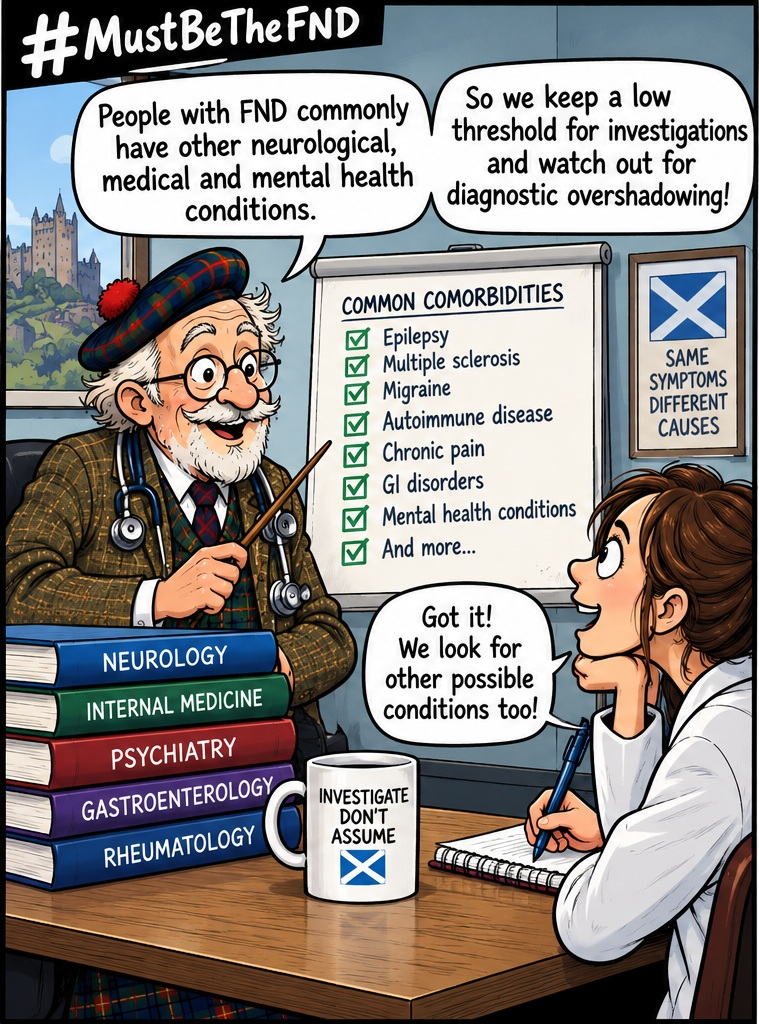
Comorbidity is the FND response to points like this. FND supposedly can be comorbid with these two conditions. FND comorbidity, however, disappears if catatonia is treated with benzodiazepines or ECT. Treating catatonia with CBT, the usually cited treatment for FND is a non-starter.
Comorbidity means having two real body diseases. It does not mean having a disease and a neurosis. It does not mean being able to use one set of symptoms twice – if it did every pregnant women would be depressed.
Schizophrenia and diabetes might look like a real medical comorbidity. In most cases, it’s likely not. A type II diabetes is caused by antipsychotics and will clear if the antipsychotics are stopped or switched to something less likely to cause weight gain. (Ironically, the first linkage of diabetes to psychosis occurred in the 1850s when diabetes (type II) was viewed as a form of male hysteria. Having two autonomous real diseases at the same time is comparatively rare.
Brain fog offers a more mundane example. For centuries people complained about constipation causing what we would now call brain fog. Other physical problems also give rise to brain fog. Tests show our brains when we complain of brain fog function normally so we could say FND, but when linked to constipation the right laxative restores mental acuity. This misattribution to brains is like thinking you have a left arm problem when you’re having a heart attack. This is not a software – real for you but not really real – problem. Back when doctors operated on the basis of professional experience, they could quickly put these brain fogs right.
SSRIs, antipsychotics, benzodiazepines and anticonvulsants all have demonstrable effects on our reflexes. Acting on the sensory inputs to our reflexes, SSRIs change our body language, facial expressions and even personalities. Spotting these changes is how they were discovered.
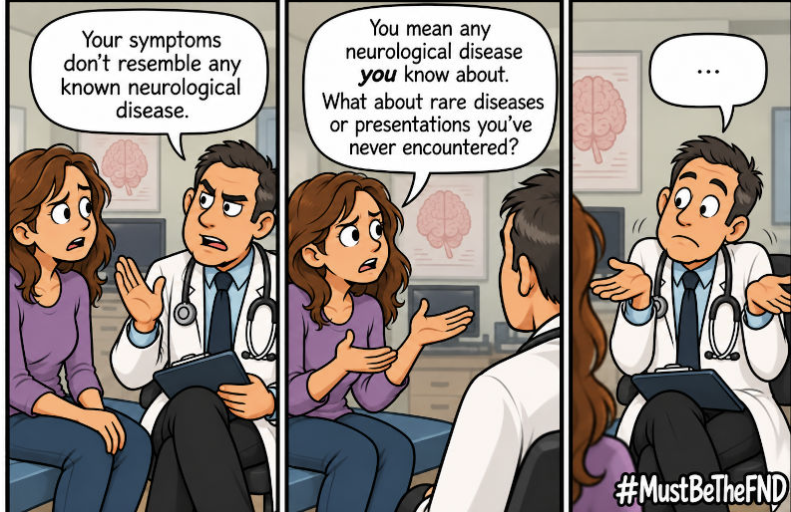
Introverts can get better than well on an SSRI, while extraverts are liable to topple over into more impulsive states, and risked until recently being labelled as borderline personality disorder – another word for hysteria (FND now). Unrecognized as drug induced states, these changes risk being viewed as linked to prior trauma affecting our wonky predictive coding systems.
Withdrawal from psychotropic drugs can last decades and few neurologists figure we must be ‘mental’ if we are complaining about something and blaming a drug out of our body for years – this is hardcore NFD..
For decades, neurologists have agreed that assessing our peripheral sensory nervous systems is complex. Subjective is the word they use. Unlike motor systems, our sensory processing varies by time of day, month or year or is gate-controlled by other things happening. Sensory neuropathies, particularly small-fiber neuropathies, do not come with ‘simple’ tests of the kind that demonstrate motor abnormalities and ‘spoil’ neurologists. It’s time for neurologists to face into a real challenge.
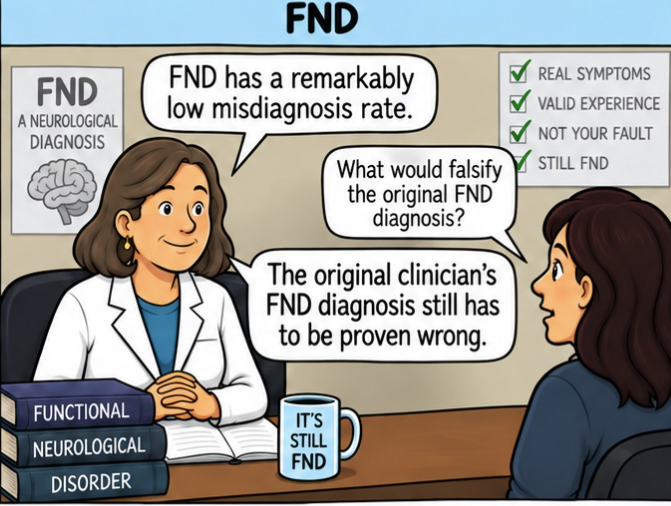
Giving up is not the right answer in the face of this ‘subjectivity’, particularly given the availability of hundreds of highly motivated free researchers and the opportunity to use a group of drugs like the SSRIs that act primarily on the peripheral sensory system – not on brains. There is chance to move not only science forward but our understanding of ourselves.
Medically Unexplained Symptoms (MUS) was initially welcomed by many of us as a recognition of an appropriate uncertainty in the face of complex medical situations and there is little that is more complex than the peripheral sensory system. However, as Marion Brown has noted in the linked post MUS seems to have transitioned into FND and now smells more like a retreat from uncertainty. This is caught in the lightly edited words of, appropriately, a Scots poet.
FND is the batsman and the bat,
FND is the bowler and the ball,
The umpire, and the alley cat,
The roller, pitch, and stumps, and all
To use another cricket analogy, given the extent to which neurologists are lining up behind the FND opinion, for us who go in alone to medical consults to bat for ourselves (or our children) it’s becoming a bit like Beachcomber’s view:
Cricket is the British idea of fair play, eleven against one.
(AI had great difficulties with this quote – it didn’t compute. It can’t help me nail down if the original is British or English. Eleven against one sounds curiously like a mistrial).
Medically NFD is alarming. We need one really really good neurologist to step in as a batsman for us – the equivalent of an Ivanhoe – to keep to the Scot’s theme.
Legally there probably isn’t a problem. Psychobabble was eliminated decades ago from legal trials and it is hard to see Judge Sullivan letting a hint of neurobabble into any trial he was running. Or, if he did, it is hard to believe 12 normal people, instructed as they were above, would buy an FND line.
With thanks to Christoff Struter for the imagery
There are loads more on fndnope.
NFD/FND – Negligent False Diagnosis – False Negligent Diagnosis
None of this FND guff makes any sense. Well done, Marion, over on Rxisk.
Why don’t they take one step at a time, like doctors should, but don’t.
If you start complaining to a doctor that something is wrong, why don’t they look at the last thing that happened to you. It could be any psychotropic drug they gave to you. They don’t do this as they are so easily persuaded by pharma, by regulators, by establishment, that it can’t possibly be the drug. They don’t listen up, if they did the scales would fall from their eyes. Neurologists are as guilty of this as the everyday GP.
I knew a psychiatrist, a softly spoken South-African, in deepest Scotland, who was itching to give me Seroxat /Paroxetine. After his clipboard exercise, he was sitting on the edge of the seat, his demeanour totally changed. He became excited, enthused about this new miraculous drug. He drew a circle on an A4 sheet. This is anxiety, at the top, this is depression, at the bottom, Paroxetine will break the cycle he maintained. I was neither depressed nor anxious, my GP persuaded me to take it.
She was confident enough to let me off it cold-turkey. I felt they were all wasting my time, I felt I didn’t need this pill.
After cold-turkey I stood on the shore road waiting for a lift to the stables. I was standing there an hour early. My heart was racing, I was trembling all over, I was crying hysterically. All the way to the stables I was in such a state, she held my hand, whilst trying to drive. I was delirious and agitated and had my pills in a bag. I would take everything going, if I were you, she said.
Neurologists don’t hear about this sort of thing. Their ears are as shut as the doctors we have. Neurologists should consider their position. They are parading themselves in the way charlatans once did. This might be living in the real world but it’s not the grown-up.
When I worked in the automotive industry, it was common for disputes to arise over the cause of a fault and, therefore, who was liable for it. If one of our aftermarket parts had failed and caused the car to fail, we were responsible for the remedy. If the manufacturer’s part had failed, they were responsible. It never ceased to amaze me how quickly a technician could declare the fault to be with the other party’s part. That was the game: tell the customer the other party’s part caused the issue, and the car would be out of your workshop and out of your hair quicker than you could say “flash”.
Now, if it was a bed instead of a car and a hospital instead of a workshop, putting something outside the domain of medicine, into the hands of psychologists or even priests, will clear out that bed quick as a flash.
Not only that, but since the current vogue among dissenters is to remove the “bio” from “biopsychosocial”, and “it’s the medical model” that is the issue, as any psychologist, social worker or occupational therapist will tell you, the doctor can give themselves a very hearty pat on the back. They haven’t merely cleared a bed. They’ve done a good deed by not “medicalising” a psychological problem.
Surely this is the worst of all possible worlds – they’ve both medicalized and psychologized the problem and diverted attention from the perpetrator (sometimes of homicide) onto the victim
D
This is the very heart of it:
‘The clash between opinions and facts is leading to mistrials and mistreatments and to Justice and Healthcare, two of the pillars of modern society, falling apart’.
And no more perfect exemplification of the ‘falling apart’ than Rebecca Jolotta’s response to Lindsay Clancy’s clear statement of the facts, as she and only she could experience them. In messages and notes RJ wrote:
•‘the symptoms sounded more like postpartum depression than medication side effects
•intrusive thoughts are quite common in postpartum depression and “mean nothing about you as a mother”
•not uncommon to hear patients say things like “I’ve never felt anything like this before” or “I just don’t feel like myself”
•the feelings, though terrible, were symptoms of a real, treatable illness that would get better.
•assessing that there was no plan or intent for suicide and not treating the statements as active suicidal ideation requiring immediate sectioning or ER evaluation.
I find it hard to articulate the feelings that this – and all opinionated translation of individual human facts into industry-disinformed garbage – give me. It’s sensory system based – something along the lines of wired irritability.
Truly, how can any healthcare professional be so stupid – and or brain-washed – to imagine that turning an obviously desperate, sleep deprived, suicidal, over-medicated young mother’s experience into a theory, her facts into ‘psychiatric opinion’, was helpful. All of us would have sounded the alarm at that moment – if not long before, straight after LC’s early reactions to doubling the dose of Zoloft.