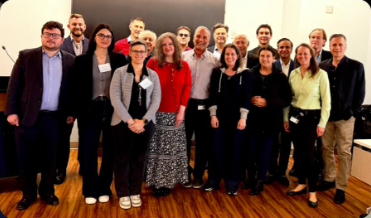
This picture comes from a meeting last week in Detroit aimed at tackling and solving the enduring sexual problems linked to Isotretinoin, SSRIs and Finasteride – See Enduring Sexual Problems World Congress.
This was a small but intense and exciting meeting. A great deal of the excitement was linked to some findings Will Powers, a Family Doctor, has come up with.
Everyone on the right hand side of this photo looks slightly shorter than they should and everyone on the left looks taller and bulkier. Will has dark hair and is second from the right in the back row.
A few months ago, he began reporting on social media that he had some interesting findings from the genomes of people with Post-Finasteride Syndrome. This caused a stir. No one was sure what to make of him or of the findings he was reporting.
He lives in Detroit – so inviting him to the Congress gave a bunch of us a chance to get to grips with him and his findings. The consensus was these are real findings, they make sense, and we could make progress by getting similar genome findings from people who have enduring sexual dysfunction after Isotretinoin and after SSRIs.
Lots of folk have been donating to PSSD Network and other Charities including RxISK’s charity to support research on these problems. In my opinion, at the moment money would be better spent on getting genomes – at least 10 to 20 Isotretinoin and 20 SSRI genomes to add to the Finasteride genomes Will already has.
We may also need genomes from some folk who have had Isotretinoin or SSRIs and have had no problems on these medicines.
Will has generated a Powers Genome Screening document linked here which is likely very different to anything you or most doctors have seen before. He has gone out of his way to avoid making claims that you stand to gain from being screened but there is a real sense in which you do.
Even if there is no genetic link to be found to these sexual problems, having a Genome Wide Screen is very likely in the near future to offer useful health information and be a useful tool for all of us.
That said, there is a good chance what Will is doing will shed light on the sexual problems we are dealing with and will inform further research needed to find a cure – in addition to highlighting things that might make things worse and that we should not be doing in efforts to treat ourselves or as research projects. – See Enduring Sexual Problems.
Volunteers Needed
We need the following volunteers – not just to solve the injuries these drugs have caused but also because the findings shed a fascinating light on our sexualities and identities. So even if you are not injured and not providing data as a control, you may find what this effort reveals made it well-worth supporting someone who is injured.
- 10 or more folk with Enduring Sexual Dysfunction Post Isotretinoin
- We will keep tabs on the people Will has and how more are needed.
- 20 or so folk with Enduring Sexual Dysfunction Post-SSRIs
- Will has genomes waiting – we will keep tabs on how many more are needed.
We will update you on the findings here.
The original post here mentioned a need for controls. The genetic deletions found in PFS are rare. This means that finding 10 PFS cases each with one of these rare deletions is so improbable that controls are not needed – for PFS. Let’s see for PSSD and PAS.
Urinary Metabolites
In a follow up post – hopefully this week – I will lay out exactly what you need to do and where you can get it and roughly how much it will cost.
When Will did genome sequenced PFS patients, the gene profile predicted a lack of urinary testosterone and other metabolites. He therefore now asks folk to check their urinary metabolites first of all and does the gene screening to confirm that there is a deletion causing their odd profiles.
It is not at the moment clear that PSSD and Isotretinoin genes will produce the same urinary metabolite profile as Finasteride. The PFS urinary metabolites are still a good starting point – but this may need updating as the gene profiles for SSRIs and Isotretinoin come in.
Costs
The costs are relatively modest – in total the urinary metabolites and gene screen should come to less than $500. It takes Will 8 hours to read and interpret a new genome and he charges $1500 for this.
He recommends sequencing.com to screen. He then uses gene.iobio to read and interpret the results. This can take 8 hours or more. At present, he ill is backed up with genomes to screen. If there is anyone out there who can figures they might be able to use gene.iobio if people get screened, we can crowd-source thoughts on what urinary metabolites the results for PSSD genomes and PAS genomes might point to as tests of the findings.
If anyone is interested to get involved but simply does not have the funds for Will’s interpretation, contact me on David.Healy@rxisk.org and we’ll see what can be organized. I can also put you in direct contact with Will.
If anyone knows how to help with genome interpretation, please get in touch.
What bundle on sequencing.com is the right one? There is more than one and I really have no idea. I am willing in doing all the tests. German here…
F
Thanks for pointing this out. I will get an answer for you and post it here.
It would be good if we can get a German or other European Department that can do the interpretation work. Will Powers has 6 months of work waiting to get done. The work is not hugely complicated or needs a lot of knowledge – it just takes time. I will check with some of my contacts but it would be good if we can track down more than one person or laboratory who can help us out here.
D
Great, thank you David. Maybe you can organize something with the German PSSD group. I think you know Sandra already, right? I will talk to her as well!
Felix
Great if you could talk to Sandra about this. If we can find a German laboratory able to do this it would be wonderful – I’m chasing a Dutch university contact among others as options for getting the testing done.
David
David,
I talked to Sandra. At the moment it seems we do not have anybody who could /would do the interpretation of the data. But she wants to send you an email in the near future anyways.
Did you already find out what DNA Sequencing Package is enough to order here in Europe.
Does it make sense to to the sequencing now or should I wait until we know how to evaluate the data. Same question go the Dutch test. Is there a preferred provider so that we are looking of the values of the same laboratory to make it more compareable?
Cheers
Felix
Felix
See the following posts in this series.
Yes – get Dutch Tests done – get a Dutch Complete Test if possible. While it would be good to have them all done in the same laboratory organising this is too complex. We an adjust for variations between laboratories and it may be useful to find out if there are variations between laboratories
Re Sequencing – wait for the moment until we see if a university laboratory is going to pick this one up in which case we will get it done there. Re interpretation this will involve teamwork and we can sort that out when we get to that point. Will Powers may also have some preliminary data at that point.
David
Hello, thanks for all. Indeed, genetic polymorphism, could alone explains the heterogeneity of responses to isotretinoin treatment.
So, concerning isotretinoin and PAS :
According to Khabour et al, 2018, the association between the rs7799039 polymorphism of the leptin gene and changes in the lipid profile induced by isotretinoin treatment could modulate the lipid parameters and liver enzymes.
According to M Garba 2020, The association between the single nucleotide of adiponectin in connection with the polymorphisms and side effects of isotretinoin in acne patients studies the ADIPOQ gene which carries rs1501299 and rs2241766, the sample size and variations due to diet require the study to be reproduced on other populations, and a larger cohort.
In the CHM report, page 26:
“3.1.2. Genetic polymorphisms Genetic polymorphisms or mutations of components of the ATRA Fox03 TRAIL death signaling cascade may explain the observed individual susceptibilities enhancing isotretinoin-mediated apoptosis. Genetic polymorphisms in the RARA gene have been associated with an increased risk of adverse effects of isotretinoin (Alzoubi et al., 2013).
Analysis of three-locus haplotypes (rs2715554 C/T rs4890109 G/T rs9303285 T/C) showed that the frequencies of the CTG and TTG haplotypes are significantly associated with the occurrence of arthralgia, myalgia, nosebleeds and headaches in patients treated with isotretinoin. These side effects are all listed in the product information as possible side effects associated with isotretinoin.
Additionally, the TCG haplotype was associated with nosebleeds and headaches, while the TTT haplotype was associated with arthralgias and myalgias. Aspartate aminotransferase (AST) levels were increased in patients with the TC genotype of the rs2715554 polymorphism, while the T allele of rs9303285 was found to be protective against the development of depression in patients treated with isotretinoin (Alzoubi, et al., 2013).
As such, genetic variations in critical regulators of isotretinoin-induced apoptotic signaling may explain subgroups at increased risk of side effects or treatment resistance while receiving systemic isotretinoin. Melnik hypothesized that screening for gene polymorphisms that increase susceptibility to isotretinoin-induced apoptosis and isotretinoin-associated depression could be useful in identifying individuals with increased isotretinoin-mediated apoptotic signaling. isotretinoin in the future (Melnik, 2017).
Genetic polymorphisms or mutations of components of the ATRA Fox03 TRAIL death signaling cascade may explain the observed individual susceptibilities enhancing isotretinoin-mediated apoptosis.
In summary, one of the main mechanisms underlying the mode of action and adverse effects of isotretinoin is apoptosis. The extent of isotretinoin-induced apoptotic signaling may depend on genetic variations, such as RARA polymorphisms. The data provide additional information on the mode of action of isotretinoin, its risk profile and may at least partly explain the increased sensitivity to adverse reactions individuals linked to apoptosis in the subgroup of people with genetic variations in isotretinoin-induced apoptotic signaling pathways. »
“Mutations of this enzyme lead to biotin deficiency (Bremner, et al., 2005), (Csoka & Szyf, 2009) . Administration of isotretinoin to humans is associated with a decrease in biotinidase (Ding, Kam, Dieckow, & Sullivan, 2013), and the presumed resulting decrease in biotin may contribute to depression. » (page 31) “
3.2.1.1.3. Genetic polymorphisms The effect of genetic polymorphisms (variations) of the RARA gene has been studied for the relationship with depression. In a study of 300 patients treated with oral isotretinoin, it was shown that the T allele of rs9303285 protected against the development of depression and that the rs2715554 and rs54890109 polymorphisms were not associated with the development of depressive symptoms during treatment. use of isotretinoin (Alzoubi, et al., 2013). However, this study requires further validation to assess possible associations and explore whether other, as yet unidentified, factors have a role in the clinical outcome of oral isotretinoin. There are currently no commercially available tests for screening for these polymorphisms. »
The gastrointestinal effects in pharmacovigilance signal are as numerous (12%) as the “depressions”. Maybe there is a link of correlation…
Medications to treat acne or iatrogenics are well digested in the gastrointestinal system), not to mention all autoimmune diseases, invisible, and yet arthralgia, myalgia, nosebleeds and headaches are significantly associated with the CTG and TTG haplotypes. These symptoms are also closely linked to fibromyalgia, myalgic encephalitis, rheumatoid arthritis, Gilbert syndrome, Chron, inflammatory bowel disease, etc….
Thanks you very much. Stéphane
Stéphane,
MTHFR deficiency, specifically the 677T allele, can cause DNA breakage and increase the cellular apoptosis rate. Reduced MTHFR activity also increases homocysteine, which can trigger apoptosis.
It is also associated with metabolic syndrome/leptin resistance, adiponectin levels, fibromyalgia, myalgic encephalitis, rheumatoid arthritis, inflammatory bowel disease and impaired detoxification by the liver….and it is considered a risk factor for depression.
So maybe they’re dancing partners.
S
The MTHFR C677T homozygous mutation can cause sexual problems, affects testosterone, increases fat mass and decreases muscle ( if Folate metabolism is inhibited)_…
“It was reported that adipogenesis increased when folate metabolism was inhibited or S-adenomethionine inhibitors were used. It was deduced that the decrease in DNA methylation profile is the reason of increased adipogenesis (Gouffon, 2012). These kinds of defects in folate metabolism can be emerged by a mutation on the MTHFR gene like MTHFR C677T polymorphism. Di Renzo et al. (2014) reported that MTHFR C677T polymorphism was found to be directly proportional to the increase in body fat mass and decrease in muscle ratio,”
https://pmc.ncbi.nlm.nih.gov/articles/PMC10388074/
“The common MTHFR C677T polymorphism affects the activity of the enzyme and hence folate distribution. under conditions of impaired Folate status, the homozygous TT genotype has been regarded as harmful because it is associated with a high concentration of plasma homocysteine” …….”and can also predispose individuals to adverse effects from drugs with anti Folate effects.”
https://www.cell.com/trends/pharmacological-sciences/abstract/S0165-6147(00)01675-8
Drugs like Isotretinoin, SSRIs and Finasteride, perhaps.
Treating the methylation problem sometimes works.
https://onlinelibrary.wiley.com/doi/full/10.1155/2020/6945124
The group “Surviving Antidepressants” has a thread where people have posted their MTHFR test results. All are positive, mostly homozygous C677T or a combination of C677T and A1298C which the literature says has the same effect.
Perhaps that’s why so many of them are having symptoms associated with the mutations when they’re triggered…brain zaps, ear pain, atrial fibrillation, neuropathy, etc
Silvia
MTHFR is commonly on sites like 23andMe because it is common – not because it is particularly informative. At the moment it is not clear that it sheds any light on PSSD or even complex SSRI withdrawal
David
This is the part that is tripping me up in terms of a rational protocol. I don’t know what we’d be looking for. It seems that in pharmacogenetics frequency isn’t so important because the problem only occurs after exposure to a drug. CYP is an obvious example, it’s common, but the effect can still be dramatic once challenged by a drug.
So it strikes me that we can’t really apply a Mendelian disease finding protocol with something like MAF <0.01% freq cuttoff. But at the same time, if we’re going case by case, we also can’t expect to discover novel causes using a pharmacogenomic approach, since we don't know enough about what we are looking for, or do we?
See post just gone up on RxIS – Love Making Actually. Not an answer to the detail of this point – which would b more as follows. If a pattern of metabolism related genes linked to a drug that feeds into this pathway predicts a crazy levels – much too high or too low – of metabolites and this is what you find, what does this do for your confusion?
If a treatment based on turning of the tap at source – which isn’t necessarily stop the drug, which is a bystander if the process has become autonomous – cures the problem what would this do?
I think we are at a point of waiting to see what happens with some test patients to see what the outcome to this is
D
Good. I thought I hadn’t understood the upshot but as soon as I read “pile up” I realised to my great relief that I had managed to keep up.
It is a very good fit in terms of not contradicting existing observations.
Having one mutation is common but in the US and UK, only 10% have a double mutation (over expressed in depression). It causes 25% enzyme activity, homocysteine 25% higher than wild type and it can cause low Folate and low Vitamin D.
According to this study, low Folate, “delayed onset of clinical improvement during treatment with fluoxetine by, on average, 1.5 wk.”
https://pubmed.ncbi.nlm.nih.gov/15877935/
So does low Vitamin D, so perhaps that’s why it takes SSRIs 4 weeks to start working. They lower both.
Homozygous C677T affects the same things as SSRIs, so it can actually be very “informative”.
S.
Silvia
The gene profile you are mentioning may be irrelevant. Older companies that screened a few of our genes generally mention it because it is abnormal in so many of us – but without causing problems. Despite the reference you cite, it is not clear that folate is of any great importance other than during pregnancy
D